Fat Melting Injections Singapore – What They Are, Risks, and Safer Alternatives
Fat melting injections are commonly searched in Singapore as a non-surgical option to reduce stubborn fat, especially in areas such as the double chin and jawline. These treatments are designed to break down fat cells through targeted injections, with the aim of improving facial or body contour without surgery.
However, there are important considerations that are often overlooked. Fat melting injections are not widely approved for aesthetic use in Singapore, and outcomes can vary depending on the product used and injection technique. In addition, these treatments are frequently misunderstood as a form of weight loss, when in reality they are only suitable for small, localised fat pockets.
In this article, we explain what fat melting injections are, how they work, the potential risks involved, and why they are not commonly used in Singapore. We also clarify how they differ from doctor-prescribed weight loss injections such as Wegovy and Mounjaro, which work through a completely different mechanism to achieve more consistent, whole-body fat reduction.
Summary
Fat melting injections (also called fat dissolving injections or injection lipolysis) are non-surgical treatments that target small, localized fat deposits, such as a double chin or jawline fat. They work by injecting substances (commonly deoxycholic acid) that break down fat cells, which the body gradually clears over several weeks.
- Not a weight-loss treatment. These injections are intended for small fat pockets, not overall body fat reduction or obesity treatment.
- Results are usually modest and gradual. Most people need multiple sessions, and improvements are often subtle rather than dramatic.
- Results can be unpredictable. Outcomes depend on the product used, injection technique, and the individual's anatomy and fat distribution.
- Potential risks include swelling, bruising, pain, uneven contouring, nodules, and possible nerve injury that can temporarily affect facial movement.
- Not widely standardized or commonly used in Singapore. The article emphasizes regulatory and safety considerations, as well as the lack of consistent treatment protocols.
- Best candidates are people with a small, well-defined fat pocket, good skin elasticity, stable weight, and realistic expectations.
- Poor candidates include those with significant weight gain, large fat deposits, loose skin, or expectations of major fat loss.
What Are Fat Melting Injections?
Fat melting injections, also known as injection lipolysis, are non-surgical treatments designed to reduce small, localised fat deposits through targeted injections. These treatments are commonly used for areas such as the double chin, jawline, and small pockets of stubborn fat that do not respond easily to diet or exercise.

How Fat Melting Injections Work
Fat melting injections typically contain compounds such as deoxycholic acid, which work by breaking down fat cell membranes. Once these fat cells are disrupted, the body gradually clears the released fat through natural metabolic processes over the following weeks.
What Areas Can Be Treated
Fat melting injections are generally used for small, well-defined areas of fat, including:
- Double chin (submental fat)
- Jawline and jowls
- Small abdominal fat pockets
- Inner thighs or upper arms
These treatments are not suitable for large-volume fat reduction or overall body weight loss.
What Results Can You Expect
Results from fat melting injections are gradual and typically become noticeable over several weeks after each session. Multiple sessions are usually required to achieve visible improvement, and the overall effect is subtle contouring rather than significant fat reduction.
While fat cells that are destroyed do not regenerate, remaining fat cells in the area can still enlarge with weight gain.
Why Fat Melting Injections Are Not Commonly Used in Singapore
While fat melting injections are widely marketed overseas, their use in Singapore remains limited due to regulatory and safety considerations. Patients often encounter these treatments online or through social media, but the local regulatory landscape and clinical concerns are important factors to understand before considering them.
Regulatory Status in Singapore
At present, there is no widely adopted, standardised fat melting injection that is commonly used for aesthetic fat reduction in Singapore.
Some formulations, such as deoxycholic acid injections, have been approved in other countries for specific indications like submental fat (double chin). However, approval status, availability, and clinical use in Singapore may differ, and treatments must comply with guidelines set by the Ministry of Health (MOH) and Health Sciences Authority (HSA).
In addition, certain forms of injection lipolysis or mesotherapy have faced restrictions due to safety concerns. As a result, these treatments are not considered a routine or standard aesthetic option in Singapore.
Variability in Products Used
Another key concern is the lack of consistency in the formulations used for fat melting injections. Different clinics may use different compounds, concentrations, or combinations of ingredients.
This variability can affect:
- Treatment effectiveness
- Safety profile
- Predictability of results
Without a standardised formulation, outcomes may differ significantly between patients and clinics, making results less reliable compared to more established treatments.
Lack of Standardised Treatment Protocols
In addition to product variability, there is no universally accepted protocol for how fat melting injections should be performed. Factors such as:
- Injection depth
- Volume injected
- Number of treatment sessions
can vary depending on the practitioner and the formulation used.
This lack of standardisation contributes to inconsistent outcomes and increases the importance of careful patient selection, clinical judgment, and a thorough understanding of facial and body anatomy.
Risks and Side Effects of Fat Melting Injections
Before considering fat melting injections, it is important to understand the potential risks involved. While these treatments are often marketed as simple, non-surgical solutions, the effects on fat tissue can lead to significant inflammation and variable outcomes depending on technique and product used.

Common Side Effects
Most patients can expect some degree of local reaction following treatment. These are typically temporary but can be more pronounced compared to other aesthetic procedures.
Common side effects include:
- Swelling (often significant, especially in the chin area)
- Bruising
- Pain or tenderness at the injection site
- Redness and firmness
Swelling can last several days to weeks, particularly when treating areas such as the double chin.
Potential Complications
Although less common, more serious complications can occur, especially if the injection is not performed at the correct depth or location.
These may include:
- Nerve injury, particularly affecting the marginal mandibular nerve, which can lead to temporary facial asymmetry or an uneven smile
- Irregular or uneven fat breakdown, resulting in contour deformities
- Prolonged inflammation or the formation of firm nodules
- Skin irregularities if fat is not reduced evenly
These risks highlight the importance of proper technique and anatomical understanding.
Why Outcomes Can Be Unpredictable
One of the key limitations of fat melting injections is the variability in results. Unlike more standardised treatments, outcomes depend heavily on multiple factors, including:
- The formulation used
- Injection technique and depth
- Individual fat distribution and metabolism
Because of these variables, results can range from subtle improvement to uneven contouring, making it difficult to achieve consistent and predictable outcomes.
Why Swelling and Downtime Are Often Underestimated
Fat melting injections trigger an inflammatory response as fat cells are broken down. This can lead to more noticeable swelling compared to other non-surgical treatments.
In areas like the submental region, swelling may temporarily make the area appear fuller before improvement is seen. Patients should be prepared for this phase and understand that visible results take time to develop.
Are Fat Melting Injections Effective?
Fat melting injections can produce visible fat reduction in selected cases, but their effectiveness is often limited and frequently overestimated. Understanding when these treatments work—and when they do not—is important for setting realistic expectations.

When Fat Melting Injections May Work
Fat melting injections are most suitable for small, well-defined fat deposits. Patients who tend to see better outcomes typically have:
- A small, localised fat pocket (e.g. under the chin)
- Good skin elasticity
- Minimal skin laxity
In these cases, gradual reduction in fat thickness can lead to modest contour improvement over time.
When Fat Melting Injections Do Not Work Well
These treatments are less effective in many common scenarios, including:
- Larger volumes of fat
- Generalised weight gain
- Loose or sagging skin
In such cases, breaking down a small amount of fat may not produce a noticeable or meaningful visual change.
Why Results Are Often Subtle
Unlike surgical fat removal, fat melting injections work gradually and typically reduce only a limited amount of fat with each session. Multiple sessions are usually required, and even then, the degree of improvement is often modest.
Patients expecting dramatic slimming or significant fat loss may find the results underwhelming.
Why Patient Selection Is Critical
One of the key factors determining success is appropriate patient selection. Treating the wrong indication—such as skin laxity instead of true fat excess—can lead to disappointing outcomes.
A proper clinical assessment is important to determine whether fat melting injections are likely to provide a meaningful benefit, or whether alternative treatments would be more suitable.
Fat Melting Injections vs Weight Loss Injections
Fat melting injections are often confused with medical weight loss injections, but they work in completely different ways and are designed for very different purposes. Understanding these differences is important when choosing the most appropriate treatment for fat reduction.
How Weight Loss Injections Work
Doctor-prescribed weight loss injections such as Wegovy and Mounjaro act on appetite regulation and metabolism. These treatments:
- Reduce hunger and food intake
- Slow gastric emptying
- Improve satiety signals
As a result, they lead to gradual, whole-body fat reduction, rather than targeting a single localised area.
Key Differences Between Fat Melting and Weight Loss Injections
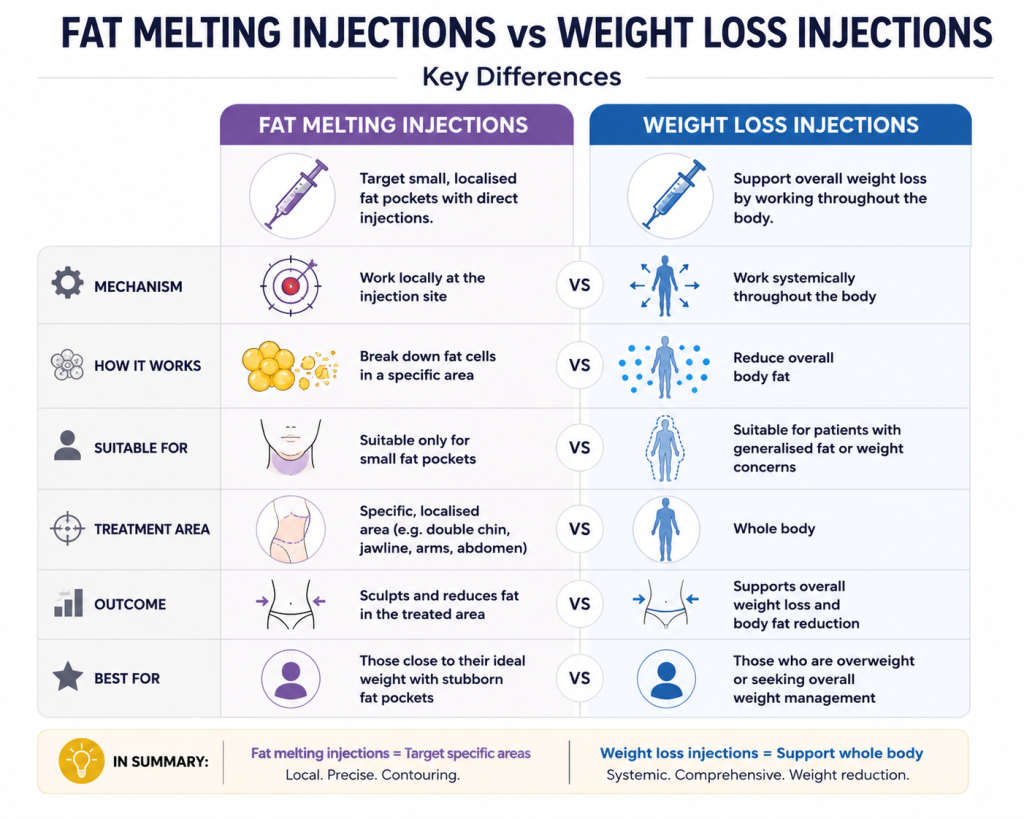
Fat melting injections and weight loss injections differ significantly in their mechanism and outcomes:
- Fat melting injections:
- Work locally at the injection site
- Break down fat cells in a specific area
- Suitable only for small fat pockets
- Weight loss injections:
- Work systemically throughout the body
- Reduce overall body fat
- Suitable for patients with generalised fat or weight concerns
Which Is More Effective for Fat Reduction
For most patients seeking noticeable fat loss, medical weight loss injections are significantly more effective.
Fat melting injections may offer some benefit for very small, stubborn areas, but they are limited in scope and impact. In contrast, weight loss injections can produce consistent, clinically meaningful fat reduction across multiple areas of the body.
When Each Treatment May Be Suitable
Both treatments have different roles depending on the clinical situation:
- Fat melting injections may be considered for:
- Small, localised fat deposits
- Patients with otherwise stable body weight
- Weight loss injections may be more suitable for:
- Generalised fat or weight concerns
- Patients seeking more significant and predictable fat reduction
A proper medical assessment is important to determine which approach is more appropriate based on individual goals and body composition.
Safer and More Effective Alternatives for Fat Reduction in Singapore
Given the limitations and variability of fat melting injections, many patients may benefit more from alternative treatments that are better studied and offer more predictable outcomes. In Singapore, a range of non-surgical and medical options are available depending on whether the concern is localised fat, skin laxity, or overall weight.
Non-Surgical Fat Reduction Treatments
Non-invasive technologies such as ultrasound-based lifting treatments (HIFU) and fat freezing (cryolipolysis) can reduce localised fat without injections.

Learn more about ultrasound-based lifting with HIFU:
Read more...

Learn more about fat freezing for localised fat reduction:
Read more...
These treatments are generally more standardised and may offer more consistent results compared to fat melting injections.
Skin Tightening and Contouring Treatments
In some cases, what appears to be “fat” may actually be due to skin laxity or loss of structural support. Treatments that focus on lifting and tightening may provide better aesthetic improvement.
Options include:
- Ultrasound-based lifting treatments (HIFU)
- Collagen-stimulating injectables
- Laser-based skin tightening treatments
Addressing the underlying cause—whether fat, skin laxity, or volume loss—is key to achieving a natural-looking result.
Medical Weight Loss Treatments
For patients with generalised fat or weight concerns, doctor-supervised medical weight loss treatments may provide more consistent and clinically meaningful fat reduction.
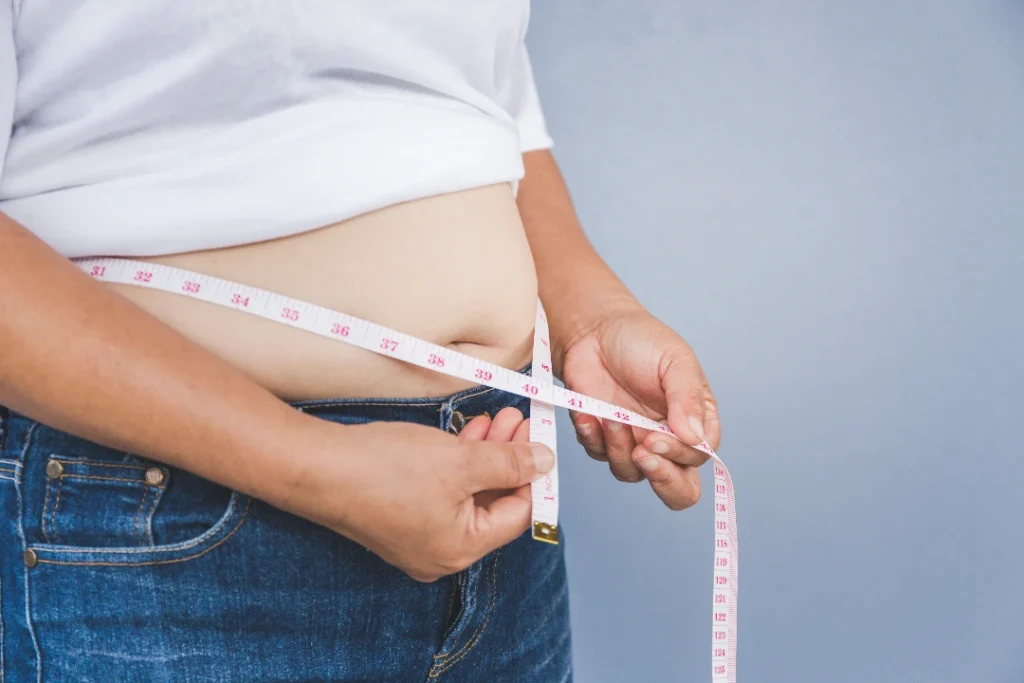
Learn more about Wegovy weight loss treatment in Singapore:
Read more...

Learn more about Mounjaro weight loss treatment in Singapore:
Read more...
These treatments work by regulating appetite and metabolism, leading to gradual fat loss across the body. Compared to localised fat treatments, they provide:
- More consistent fat reduction
- Greater overall improvement in body composition
- Longer-term sustainability when used appropriately
Liposuction for Larger Fat Reduction
For patients with larger or more significant fat deposits, surgical options such as liposuction may be considered. Liposuction physically removes fat cells and can achieve more immediate and noticeable fat reduction compared to non-surgical treatments.
However, liposuction:
- Is an invasive surgical procedure
- Requires downtime and recovery
- Carries surgical risks such as infection, bleeding, and contour irregularities
While liposuction can be effective for larger areas of fat, it is typically considered when non-surgical options are insufficient or when more significant fat reduction is desired.
Choosing the Right Treatment Approach
Selecting the most appropriate treatment depends on several factors, including:
- Whether the concern is localised fat or generalised weight
- Presence of skin laxity
- Desired degree of improvement
A personalised assessment is important to determine the most suitable approach, rather than relying on a single treatment modality.
Doctor’s Perspective – Should You Consider Fat Melting Injections?
From a clinical standpoint, fat melting injections have a limited and highly specific role in fat reduction. While they may be useful in selected cases, they are often not the most effective or predictable option for most patients seeking noticeable fat loss or contour improvement.
It is also important to note that fat melting injections are not widely standardised or commonly used in Singapore, and their use is influenced by regulatory and safety considerations.
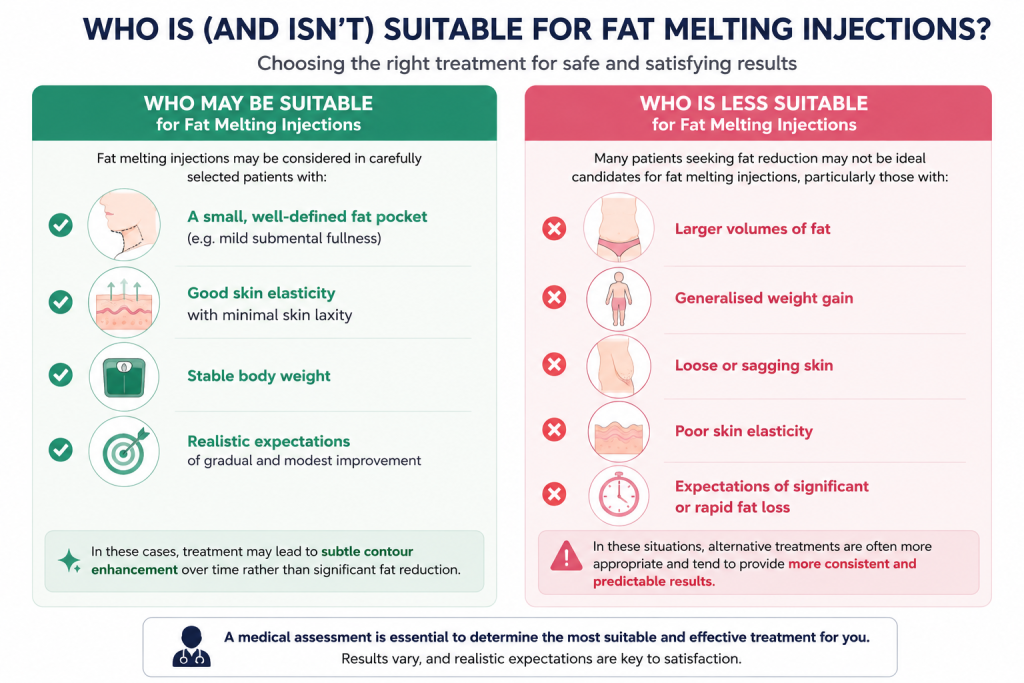
Who May Be Suitable for Fat Melting Injections
Fat melting injections may be considered in carefully selected patients with:
- A small, well-defined fat pocket (e.g. mild submental fullness)
- Good skin elasticity with minimal skin laxity
- Stable body weight
- Realistic expectations of gradual and modest improvement
In these cases, treatment may lead to subtle contour enhancement over time rather than significant fat reduction.
Who Is Less Suitable for This Treatment
Many patients seeking fat reduction may not be ideal candidates for fat melting injections, particularly those with:
- Larger volumes of fat
- Generalised weight gain
- Loose or sagging skin
- Poor skin elasticity
- Expectations of significant or rapid fat loss
In these situations, alternative treatments are often more appropriate and tend to provide more consistent and predictable results.
Importance of Accurate Diagnosis
One of the most common reasons for suboptimal outcomes is incorrect diagnosis of the underlying concern. What appears to be “fat” may instead be due to:
- Skin laxity
- Loss of facial support or volume
- Muscle-related contour changes
Treating fat alone in these cases may not result in meaningful or visible improvement.
A More Predictable Treatment Strategy
In clinical practice, achieving natural and consistent results requires selecting treatments based on the primary cause of the concern rather than relying on a single modality.
For example:
- Localised fat → targeted fat reduction or contouring treatments
- Skin laxity → lifting and skin tightening procedures
- Generalised fat → doctor-supervised medical weight loss treatments
This structured approach improves treatment predictability and overall outcomes, while reducing the risk of underwhelming results.
Frequently Asked Questions About Fat Melting Injections in Singapore
Patients considering fat melting injections often have questions about safety, effectiveness, and how these treatments compare to other fat reduction options. The answers below address common concerns based on clinical practice and the regulatory context in Singapore.
Are Fat Melting Injections Approved In Singapore?
Fat melting injections are not widely standardised or commonly used as a routine aesthetic treatment in Singapore. While certain formulations are approved overseas, their availability and use locally may differ and must comply with guidelines set by the Ministry of Health (MOH) and Health Sciences Authority (HSA).
How Many Sessions Are Needed For Fat Melting Injections?
Most patients require multiple sessions to achieve visible results. Depending on the area treated and the amount of fat present, this typically ranges from 2 to 6 sessions spaced a few weeks apart. Gradual improvement is expected rather than immediate fat reduction.
Is The Fat Removal Permanent?
Fat cells that are destroyed do not regenerate. However, remaining fat cells in the treated area can still enlarge with weight gain, which may affect long-term results. Maintaining a stable weight is important to preserve outcomes.
Are Fat Melting Injections Safe?
Fat melting injections can be safe when performed appropriately, but they are associated with side effects such as swelling, bruising, and discomfort. There are also potential risks including nerve injury and uneven contouring, particularly if the injection technique or formulation used is not well controlled.
What Is The Downtime After Fat Melting Injections?
Downtime varies depending on the treatment area, but swelling is common and can be significant, especially for the double chin. This swelling may last several days to weeks before gradually improving. Bruising and tenderness may also occur.
Do Fat Melting Injections Work For Weight Loss?
Fat melting injections are not designed for weight loss. They only target small, localised fat pockets and do not reduce overall body fat. For patients seeking weight loss, doctor-prescribed treatments such as Wegovy and Mounjaro are more effective as they work systemically to reduce appetite and promote gradual fat loss.
Are Fat Melting Injections Better Than Liposuction?
Fat melting injections and liposuction serve different purposes. Fat melting injections are used for small, localised fat deposits and produce gradual, subtle results. Liposuction is a surgical procedure that removes larger volumes of fat and provides more immediate and noticeable fat reduction, but it involves downtime and surgical risks.
What Areas Can Fat Melting Injections Treat?
Fat melting injections are typically used for small areas such as the double chin, jawline, and minor fat pockets on the body. They are not suitable for large areas or generalised fat reduction.
Why Are Results From Fat Melting Injections So Variable?
Results can vary due to differences in product formulation, injection technique, and individual fat distribution. The lack of standardisation means outcomes may be less predictable compared to other fat reduction treatments.
What Is The Best Alternative To Fat Melting Injections In Singapore?
The best alternative depends on the underlying concern. Non-surgical treatments such as fat freezing or HIFU may be suitable for localised fat, while medical weight loss injections such as Wegovy and Mounjaro are more effective for overall fat reduction. A personalised assessment is important to determine the most appropriate treatment approach.
Conclusion – Understanding Fat Reduction Options in Singapore
Fat melting injections are often marketed as a simple, non-surgical solution for stubborn fat. However, their role in clinical practice is limited, and results can vary depending on the indication, product formulation, and injection technique used.
These treatments are best suited for small, localised fat pockets and are not designed for overall weight loss or significant fat reduction. In Singapore, regulatory considerations and the lack of standardisation also mean that fat melting injections are not commonly used as a routine aesthetic treatment.
For many patients, alternative approaches such as non-surgical fat reduction, skin tightening treatments, or doctor-supervised medical weight loss may provide more predictable and clinically meaningful outcomes. The most appropriate treatment depends on whether the concern is localised fat, skin laxity, or generalised weight gain.
A personalised medical assessment remains the most important step in determining the most suitable approach, ensuring that treatment is tailored to achieve natural, balanced, and realistic results.
Book A Consultation
If you are considering fat melting injections or exploring alternative fat reduction treatments, a personalised medical assessment is important to determine the most appropriate approach for your concerns.

You may contact us here to arrange a consultation:
Read more...


