Fat Melting Injections Singapore – What They Are, Risks, and Safer Alternatives

Fat melting injections are commonly searched in Singapore as a non-surgical option to reduce stubborn fat, especially in areas such as the double chin and jawline. These treatments are designed to break down fat cells through targeted injections, with the aim of improving facial or body contour without surgery.

However, there are important considerations that are often overlooked. Fat melting injections are not widely approved for aesthetic use in Singapore, and outcomes can vary depending on the product used and injection technique. In addition, these treatments are frequently misunderstood as a form of weight loss, when in reality they are only suitable for small, localised fat pockets.

In this article, we explain what fat melting injections are, how they work, the potential risks involved, and why they are not commonly used in Singapore. We also clarify how they differ from doctor-prescribed weight loss injections such as Wegovy and Mounjaro, which work through a completely different mechanism to achieve more consistent, whole-body fat reduction.

What Are Fat Melting Injections?

Fat melting injections, also known as injection lipolysis, are non-surgical treatments designed to reduce small, localised fat deposits through targeted injections. These treatments are commonly used for areas such as the double chin, jawline, and small pockets of stubborn fat that do not respond easily to diet or exercise.

How Fat Melting Injections Work

Fat melting injections typically contain compounds such as deoxycholic acid, which work by breaking down fat cell membranes. Once these fat cells are disrupted, the body gradually clears the released fat through natural metabolic processes over the following weeks.

What Areas Can Be Treated

Fat melting injections are generally used for small, well-defined areas of fat, including:

These treatments are not suitable for large-volume fat reduction or overall body weight loss.

What Results Can You Expect

Results from fat melting injections are gradual and typically become noticeable over several weeks after each session. Multiple sessions are usually required to achieve visible improvement, and the overall effect is subtle contouring rather than significant fat reduction.

While fat cells that are destroyed do not regenerate, remaining fat cells in the area can still enlarge with weight gain.

Why Fat Melting Injections Are Not Commonly Used in Singapore

While fat melting injections are widely marketed overseas, their use in Singapore remains limited due to regulatory and safety considerations. Patients often encounter these treatments online or through social media, but the local regulatory landscape and clinical concerns are important factors to understand before considering them.

Regulatory Status in Singapore

At present, there is no widely adopted, standardised fat melting injection that is commonly used for aesthetic fat reduction in Singapore.

Some formulations, such as deoxycholic acid injections, have been approved in other countries for specific indications like submental fat (double chin). However, approval status, availability, and clinical use in Singapore may differ, and treatments must comply with guidelines set by the Ministry of Health (MOH) and Health Sciences Authority (HSA).

In addition, certain forms of injection lipolysis or mesotherapy have faced restrictions due to safety concerns. As a result, these treatments are not considered a routine or standard aesthetic option in Singapore.

Variability in Products Used

Another key concern is the lack of consistency in the formulations used for fat melting injections. Different clinics may use different compounds, concentrations, or combinations of ingredients.

This variability can affect:

Without a standardised formulation, outcomes may differ significantly between patients and clinics, making results less reliable compared to more established treatments.

Lack of Standardised Treatment Protocols

In addition to product variability, there is no universally accepted protocol for how fat melting injections should be performed. Factors such as:

can vary depending on the practitioner and the formulation used.

This lack of standardisation contributes to inconsistent outcomes and increases the importance of careful patient selection, clinical judgment, and a thorough understanding of facial and body anatomy.

Risks and Side Effects of Fat Melting Injections

Before considering fat melting injections, it is important to understand the potential risks involved. While these treatments are often marketed as simple, non-surgical solutions, the effects on fat tissue can lead to significant inflammation and variable outcomes depending on technique and product used.

Common Side Effects

Most patients can expect some degree of local reaction following treatment. These are typically temporary but can be more pronounced compared to other aesthetic procedures.

Common side effects include:

Swelling can last several days to weeks, particularly when treating areas such as the double chin.

Potential Complications

Although less common, more serious complications can occur, especially if the injection is not performed at the correct depth or location.

These may include:

These risks highlight the importance of proper technique and anatomical understanding.

Why Outcomes Can Be Unpredictable

One of the key limitations of fat melting injections is the variability in results. Unlike more standardised treatments, outcomes depend heavily on multiple factors, including:

Because of these variables, results can range from subtle improvement to uneven contouring, making it difficult to achieve consistent and predictable outcomes.

Why Swelling and Downtime Are Often Underestimated

Fat melting injections trigger an inflammatory response as fat cells are broken down. This can lead to more noticeable swelling compared to other non-surgical treatments.

In areas like the submental region, swelling may temporarily make the area appear fuller before improvement is seen. Patients should be prepared for this phase and understand that visible results take time to develop.

Are Fat Melting Injections Effective?

Fat melting injections can produce visible fat reduction in selected cases, but their effectiveness is often limited and frequently overestimated. Understanding when these treatments work—and when they do not—is important for setting realistic expectations.

When Fat Melting Injections May Work

Fat melting injections are most suitable for small, well-defined fat deposits. Patients who tend to see better outcomes typically have:

In these cases, gradual reduction in fat thickness can lead to modest contour improvement over time.

When Fat Melting Injections Do Not Work Well

These treatments are less effective in many common scenarios, including:

In such cases, breaking down a small amount of fat may not produce a noticeable or meaningful visual change.

Why Results Are Often Subtle

Unlike surgical fat removal, fat melting injections work gradually and typically reduce only a limited amount of fat with each session. Multiple sessions are usually required, and even then, the degree of improvement is often modest.

Patients expecting dramatic slimming or significant fat loss may find the results underwhelming.

Why Patient Selection Is Critical

One of the key factors determining success is appropriate patient selection. Treating the wrong indication—such as skin laxity instead of true fat excess—can lead to disappointing outcomes.

A proper clinical assessment is important to determine whether fat melting injections are likely to provide a meaningful benefit, or whether alternative treatments would be more suitable.

Fat Melting Injections vs Weight Loss Injections

Fat melting injections are often confused with medical weight loss injections, but they work in completely different ways and are designed for very different purposes. Understanding these differences is important when choosing the most appropriate treatment for fat reduction.

How Weight Loss Injections Work

Doctor-prescribed weight loss injections such as Wegovy and Mounjaro act on appetite regulation and metabolism. These treatments:

As a result, they lead to gradual, whole-body fat reduction, rather than targeting a single localised area.

Key Differences Between Fat Melting and Weight Loss Injections
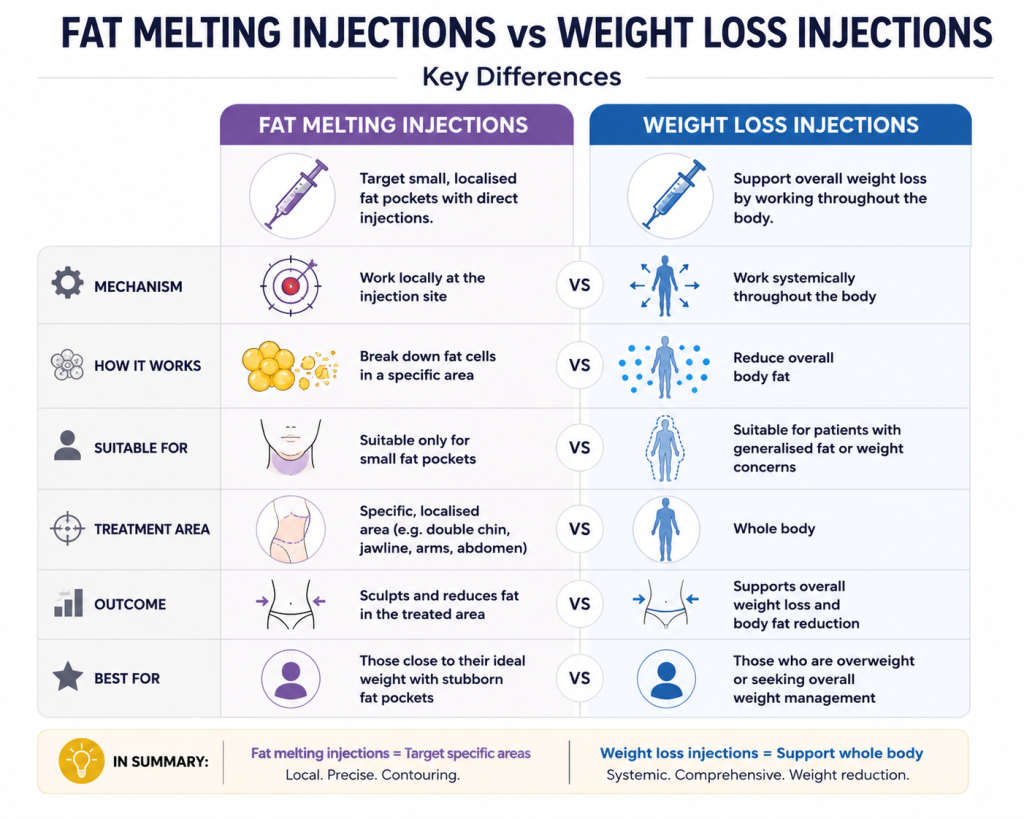
Fat melting injections and weight loss injections differ significantly in their mechanism and outcomes:

Which Is More Effective for Fat Reduction

For most patients seeking noticeable fat loss, medical weight loss injections are significantly more effective.

Fat melting injections may offer some benefit for very small, stubborn areas, but they are limited in scope and impact. In contrast, weight loss injections can produce consistent, clinically meaningful fat reduction across multiple areas of the body.

When Each Treatment May Be Suitable

Both treatments have different roles depending on the clinical situation:

A proper medical assessment is important to determine which approach is more appropriate based on individual goals and body composition.

Safer and More Effective Alternatives for Fat Reduction in Singapore

Given the limitations and variability of fat melting injections, many patients may benefit more from alternative treatments that are better studied and offer more predictable outcomes. In Singapore, a range of non-surgical and medical options are available depending on whether the concern is localised fat, skin laxity, or overall weight.

Non-Surgical Fat Reduction Treatments

Non-invasive technologies such as ultrasound-based lifting treatments (HIFU) and fat freezing (cryolipolysis) can reduce localised fat without injections.

Learn more about ultrasound-based lifting with HIFU:
Read more...

Learn more about fat freezing for localised fat reduction:
Read more...

These treatments are generally more standardised and may offer more consistent results compared to fat melting injections.

Skin Tightening and Contouring Treatments

In some cases, what appears to be “fat” may actually be due to skin laxity or loss of structural support. Treatments that focus on lifting and tightening may provide better aesthetic improvement.

Options include:

Addressing the underlying cause—whether fat, skin laxity, or volume loss—is key to achieving a natural-looking result.

Medical Weight Loss Treatments

For patients with generalised fat or weight concerns, doctor-supervised medical weight loss treatments may provide more consistent and clinically meaningful fat reduction.

Learn more about Wegovy weight loss treatment in Singapore:
Read more...

Learn more about Mounjaro weight loss treatment in Singapore:
Read more...

These treatments work by regulating appetite and metabolism, leading to gradual fat loss across the body. Compared to localised fat treatments, they provide:

Liposuction for Larger Fat Reduction

For patients with larger or more significant fat deposits, surgical options such as liposuction may be considered. Liposuction physically removes fat cells and can achieve more immediate and noticeable fat reduction compared to non-surgical treatments.

However, liposuction:

While liposuction can be effective for larger areas of fat, it is typically considered when non-surgical options are insufficient or when more significant fat reduction is desired.

Choosing the Right Treatment Approach

Selecting the most appropriate treatment depends on several factors, including:

A personalised assessment is important to determine the most suitable approach, rather than relying on a single treatment modality.

Doctor’s Perspective – Should You Consider Fat Melting Injections?

From a clinical standpoint, fat melting injections have a limited and highly specific role in fat reduction. While they may be useful in selected cases, they are often not the most effective or predictable option for most patients seeking noticeable fat loss or contour improvement.

It is also important to note that fat melting injections are not widely standardised or commonly used in Singapore, and their use is influenced by regulatory and safety considerations.
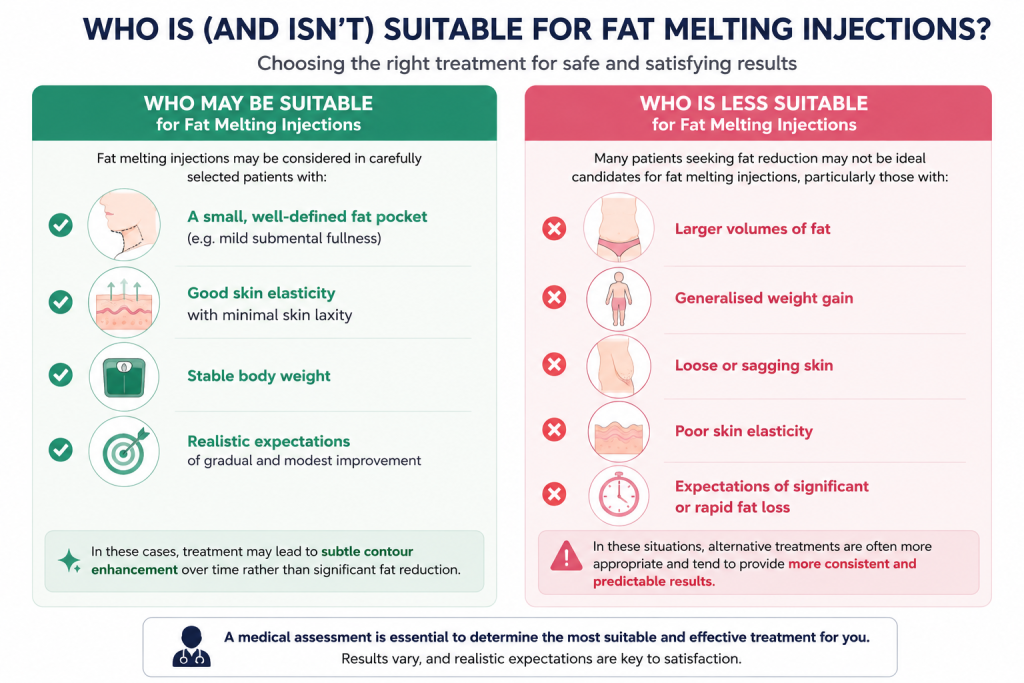
Who May Be Suitable for Fat Melting Injections

Fat melting injections may be considered in carefully selected patients with:

In these cases, treatment may lead to subtle contour enhancement over time rather than significant fat reduction.

Who Is Less Suitable for This Treatment

Many patients seeking fat reduction may not be ideal candidates for fat melting injections, particularly those with:

In these situations, alternative treatments are often more appropriate and tend to provide more consistent and predictable results.

Importance of Accurate Diagnosis

One of the most common reasons for suboptimal outcomes is incorrect diagnosis of the underlying concern. What appears to be “fat” may instead be due to:

Treating fat alone in these cases may not result in meaningful or visible improvement.

A More Predictable Treatment Strategy

In clinical practice, achieving natural and consistent results requires selecting treatments based on the primary cause of the concern rather than relying on a single modality.

For example:

This structured approach improves treatment predictability and overall outcomes, while reducing the risk of underwhelming results.

Frequently Asked Questions About Fat Melting Injections in Singapore

Patients considering fat melting injections often have questions about safety, effectiveness, and how these treatments compare to other fat reduction options. The answers below address common concerns based on clinical practice and the regulatory context in Singapore.

Are Fat Melting Injections Approved In Singapore?

Fat melting injections are not widely standardised or commonly used as a routine aesthetic treatment in Singapore. While certain formulations are approved overseas, their availability and use locally may differ and must comply with guidelines set by the Ministry of Health (MOH) and Health Sciences Authority (HSA).

How Many Sessions Are Needed For Fat Melting Injections?

Most patients require multiple sessions to achieve visible results. Depending on the area treated and the amount of fat present, this typically ranges from 2 to 6 sessions spaced a few weeks apart. Gradual improvement is expected rather than immediate fat reduction.

Is The Fat Removal Permanent?

Fat cells that are destroyed do not regenerate. However, remaining fat cells in the treated area can still enlarge with weight gain, which may affect long-term results. Maintaining a stable weight is important to preserve outcomes.

Are Fat Melting Injections Safe?

Fat melting injections can be safe when performed appropriately, but they are associated with side effects such as swelling, bruising, and discomfort. There are also potential risks including nerve injury and uneven contouring, particularly if the injection technique or formulation used is not well controlled.

What Is The Downtime After Fat Melting Injections?

Downtime varies depending on the treatment area, but swelling is common and can be significant, especially for the double chin. This swelling may last several days to weeks before gradually improving. Bruising and tenderness may also occur.

Do Fat Melting Injections Work For Weight Loss?

Fat melting injections are not designed for weight loss. They only target small, localised fat pockets and do not reduce overall body fat. For patients seeking weight loss, doctor-prescribed treatments such as Wegovy and Mounjaro are more effective as they work systemically to reduce appetite and promote gradual fat loss.

Are Fat Melting Injections Better Than Liposuction?

Fat melting injections and liposuction serve different purposes. Fat melting injections are used for small, localised fat deposits and produce gradual, subtle results. Liposuction is a surgical procedure that removes larger volumes of fat and provides more immediate and noticeable fat reduction, but it involves downtime and surgical risks.

What Areas Can Fat Melting Injections Treat?

Fat melting injections are typically used for small areas such as the double chin, jawline, and minor fat pockets on the body. They are not suitable for large areas or generalised fat reduction.

Why Are Results From Fat Melting Injections So Variable?

Results can vary due to differences in product formulation, injection technique, and individual fat distribution. The lack of standardisation means outcomes may be less predictable compared to other fat reduction treatments.

What Is The Best Alternative To Fat Melting Injections In Singapore?

The best alternative depends on the underlying concern. Non-surgical treatments such as fat freezing or HIFU may be suitable for localised fat, while medical weight loss injections such as Wegovy and Mounjaro are more effective for overall fat reduction. A personalised assessment is important to determine the most appropriate treatment approach.

Conclusion – Understanding Fat Reduction Options in Singapore

Fat melting injections are often marketed as a simple, non-surgical solution for stubborn fat. However, their role in clinical practice is limited, and results can vary depending on the indication, product formulation, and injection technique used.

These treatments are best suited for small, localised fat pockets and are not designed for overall weight loss or significant fat reduction. In Singapore, regulatory considerations and the lack of standardisation also mean that fat melting injections are not commonly used as a routine aesthetic treatment.

For many patients, alternative approaches such as non-surgical fat reduction, skin tightening treatments, or doctor-supervised medical weight loss may provide more predictable and clinically meaningful outcomes. The most appropriate treatment depends on whether the concern is localised fat, skin laxity, or generalised weight gain.

A personalised medical assessment remains the most important step in determining the most suitable approach, ensuring that treatment is tailored to achieve natural, balanced, and realistic results.

Book A Consultation

If you are considering fat melting injections or exploring alternative fat reduction treatments, a personalised medical assessment is important to determine the most appropriate approach for your concerns.

You may contact us here to arrange a consultation:
Read more...

Fat Dissolving Injections vs Weight Loss Injections – Which Is More Effective for Fat Loss?

Fat dissolving injections and weight loss injections are both commonly discussed options for fat reduction in Singapore, but they work in fundamentally different ways and are designed for different treatment goals. Understanding these differences is important when deciding which approach is more suitable.

Fat dissolving injections target small, localised fat deposits by breaking down fat cells in specific areas such as the double chin or jawline. In contrast, medical weight loss injections work systemically by regulating appetite, slowing gastric emptying, and influencing hormonal pathways involved in metabolism, leading to gradual fat reduction across the body.

Because of these differences, the results achieved with each treatment can vary significantly. Fat dissolving injections are generally limited to subtle contour improvement in small areas, while weight loss injections are used for broader fat loss and long-term weight management.

In this article, we compare fat dissolving injections and medical weight loss injections in terms of how they work, their effectiveness, and when each approach may be appropriate. This helps to provide a clearer understanding of which treatment may offer more meaningful and predictable fat loss outcomes.

Understanding Fat Dissolving Injections

Fat dissolving injections are commonly used for reducing small, localised fat deposits in aesthetic practice. They are not designed for overall weight loss and are best suited for specific areas of stubborn fat rather than generalised fat reduction.

What Are Fat Dissolving Injections

Fat dissolving injections, also known as injection lipolysis, involve injecting compounds into fat tissue to break down fat cells. These treatments commonly use substances such as Deoxycholic acid, which disrupt fat cell membranes and lead to gradual fat breakdown and clearance by the body.

This approach is typically used for contouring small, localised fat deposits rather than achieving significant or overall fat loss.

Limitations of Fat Dissolving Injections

While fat dissolving injections may provide improvement in selected cases, they have several important limitations:

Because of these limitations, fat dissolving injections are generally not suitable for patients seeking noticeable or widespread fat loss.

What Are Weight Loss Injections?

Weight loss injections are doctor-prescribed treatments designed to reduce overall body fat by acting on appetite, satiety, and metabolic pathways. Unlike fat dissolving injections, which work locally on specific areas, these treatments work systemically to support gradual and sustained fat loss.

How GLP-1 Weight Loss Injections Work

Weight loss injections commonly act on the GLP-1 receptor pathway, which plays a key role in regulating appetite and blood sugar levels. This class of treatments includes once-weekly GLP-1 injections based on active ingredients such as Semaglutide.

These treatments work by:

  • Reducing hunger signals in the brain
  • Slowing gastric emptying, leading to prolonged fullness
  • Enhancing satiety after meals

Learn more about semaglutide-based weight loss injections:
Read more...

Dual-Pathway Weight Loss Injections (GLP-1 + GIP)

Some newer weight loss injections also target the GIP receptor in addition to GLP-1. These treatments use active ingredients such as Tirzepatide and represent a more advanced approach to medical weight loss.

This dual-pathway approach:

  • Enhances appetite regulation
  • May improve metabolic efficiency
  • Can lead to greater fat loss compared to single-pathway treatments

Learn more about dual-pathway weight loss injections (GLP-1 + GIP):
Read more...

What Results Can Be Expected

Weight loss injections are designed for overall fat reduction rather than targeting specific areas.

Patients may experience:

Because these treatments act on underlying appetite and metabolic pathways, they tend to provide more consistent and predictable fat loss compared to localised fat reduction approaches.

Key Differences Between Fat Dissolving Injections and Weight Loss Injections

Fat dissolving injections and weight loss injections differ significantly in how they work, the type of fat they target, and the results they can achieve. Understanding these differences is important when deciding which approach is more suitable for fat reduction.

Localised Fat Reduction vs Whole-Body Fat Loss

Fat dissolving injections work locally by breaking down fat in specific areas such as the double chin or small fat pockets. In contrast, weight loss injections act systemically, leading to fat reduction across the entire body.

This means fat dissolving injections are used for contouring, while weight loss injections are used for overall fat loss.

Mechanism of Action

Fat dissolving injections rely on direct fat cell destruction at the injection site, commonly using compounds such as Deoxycholic acid.

Weight loss injections act on hormonal pathways such as the GLP-1 receptor and, in some cases, the GIP receptor, helping to regulate appetite, satiety, and metabolism.

Scale of Fat Reduction

Fat dissolving injections typically produce modest fat reduction limited to small treatment areas.

Weight loss injections can lead to more significant fat loss across multiple areas of the body, making them more suitable for patients with generalised fat or weight concerns.

For patients seeking clinically meaningful fat loss, these treatments are often preferred over localised fat reduction approaches.

Predictability of Results

Results from fat dissolving injections can be variable due to differences in formulation, treatment approach, and individual response.

Weight loss injections tend to produce more consistent and predictable outcomes when used under medical supervision.

Treatment Approach

Fat dissolving injections are performed as a series of localised treatment sessions targeting specific areas.

Weight loss injections are used as part of an ongoing treatment plan aimed at gradual and sustained fat loss over time.

Which Is More Effective for Weight Loss and Fat Reduction?

When comparing fat dissolving injections and weight loss injections, the effectiveness of each treatment depends largely on the goal—whether it is localised contouring or overall fat reduction. For most patients seeking meaningful fat loss, the difference in outcomes can be significant.

For Small, Localised Fat Deposits

Fat dissolving injections may be considered for small, well-defined areas of fat, such as the double chin or minor fat pockets.

In these cases:

They may be suitable for contour refinement, but their impact on overall body fat is limited.

For Overall Weight Loss and Body Fat Reduction

Weight loss injections are generally more effective for patients seeking broader fat reduction.

These treatments:

Because they work systemically, they are able to produce more noticeable and clinically meaningful fat loss compared to localised treatments.

For Long-Term Weight Management

Fat dissolving injections do not play a role in long-term weight control, as they only target specific areas without influencing appetite or metabolism.

Weight loss injections, on the other hand:

Overall Comparison

For most patients seeking effective fat loss, weight loss injections offer a more comprehensive and predictable approach.

Fat dissolving injections may still have a role in selected cases for small areas of stubborn fat, but they are not a substitute for treatments designed to achieve overall weight reduction.

Why Many Patients Choose Weight Loss Injections Instead

As patients become more informed about fat reduction options, many are moving away from localised treatments and choosing medical weight loss injections for more consistent and meaningful results. This shift reflects a better understanding of how fat loss occurs and what is required to achieve noticeable outcomes.

More Consistent and Predictable Fat Loss

Weight loss injections act on appetite and metabolic pathways, leading to a more uniform reduction in body fat. Compared to fat dissolving injections, which can produce variable results depending on the area treated, systemic treatments tend to offer more consistent outcomes across different individuals.

Addresses the Underlying Cause of Weight Gain

Fat dissolving injections focus only on removing fat from a specific area. In contrast, weight loss injections work on the underlying drivers of weight gain, including appetite regulation and caloric intake.

By influencing these factors, patients are able to:

No Need for Multiple Localised Treatments

Fat dissolving injections typically require multiple sessions for each treatment area, and additional areas would need to be treated separately.

Weight loss injections:

More Suitable for Most Patients Seeking Fat Loss

For patients with generalised fat or weight concerns, systemic weight loss treatments are often more appropriate.

They provide:

As a result, many patients seeking effective fat loss prefer treatments that address the body as a whole rather than focusing on isolated areas.

Potential Benefits Beyond Fat Loss

In addition to supporting fat reduction, medical weight loss treatments may also contribute to improvements in metabolic health when used under appropriate medical supervision.

These may include:

While individual outcomes can vary, these broader effects are one reason why systemic weight loss treatments are often considered more comprehensive compared to localised fat reduction approaches.

When Fat Dissolving Injections May Still Be Considered

While weight loss injections are generally more effective for overall fat reduction, fat dissolving injections may still have a role in selected situations. Understanding when they may be appropriate helps provide a balanced view of both treatment options.

For Very Small, Localised Fat Deposits

Fat dissolving injections may be considered for small, well-defined fat pockets that are resistant to diet and exercise.

These typically include:

In such cases, they may provide subtle contour improvement.

For Patients at Stable Body Weight

Patients who are already at or near their ideal body weight but have a specific area of concern may benefit more from localised treatments.

Fat dissolving injections may be suitable when:

As a Complement to Weight Loss Treatments

In some cases, fat dissolving injections may be used after weight loss to address small residual fat pockets that remain despite overall fat reduction.

This approach:

Importance of Proper Patient Selection

Careful patient selection is important to achieving satisfactory results.

Fat dissolving injections are most appropriate when:

In many cases, alternative approaches may still provide more predictable outcomes, particularly when larger areas of fat or overall weight concerns are involved.

Doctor’s Perspective – Choosing the Right Fat Loss Treatment

From a clinical perspective, the choice between fat dissolving injections and weight loss injections depends on the type of fat concern, overall body composition, and treatment goals. These treatments serve different purposes, and selecting the appropriate approach is key to achieving meaningful and predictable results.

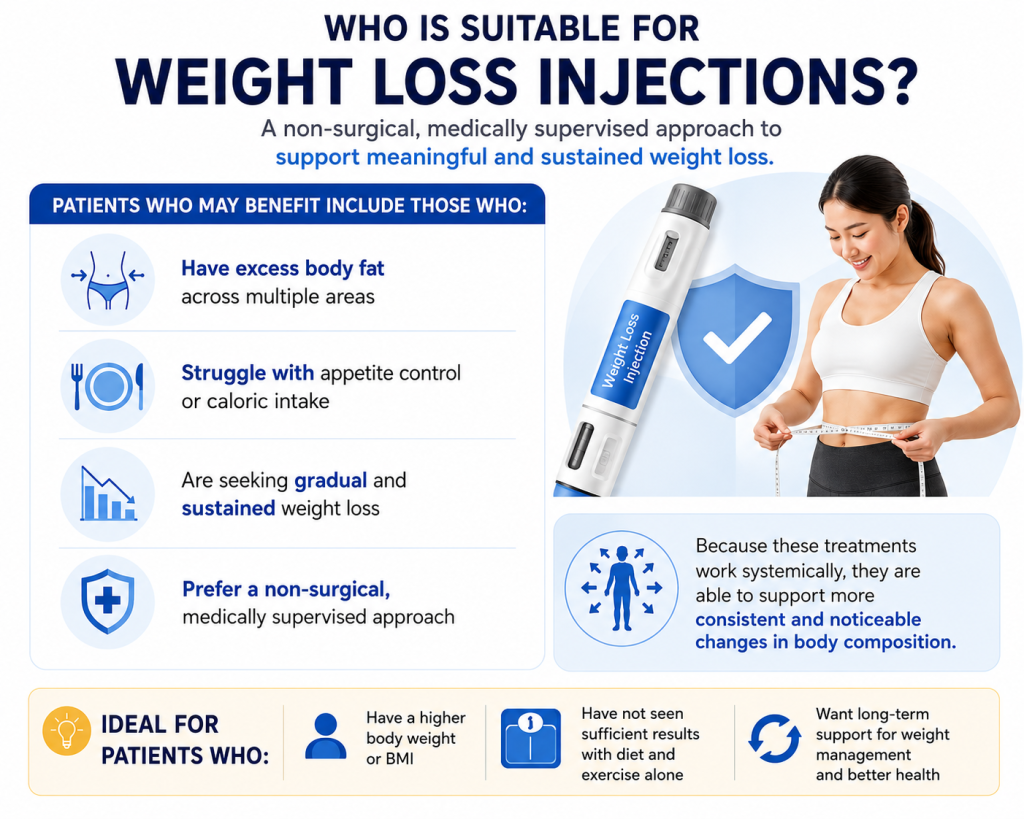
Who Is Suitable for Weight Loss Injections

Weight loss injections are generally more suitable for patients with generalised fat or weight concerns, particularly when there is a need for broader fat reduction.

Patients who may benefit include those who:

Because these treatments work systemically, they are able to support more consistent and noticeable changes in body composition.

Who May Consider Fat Dissolving Injections

Fat dissolving injections may be considered in selected patients with very specific concerns.

These include patients who:

In these cases, fat dissolving injections may play a role in targeted contour refinement.

Importance of Individual Assessment

One of the most important factors in achieving good outcomes is proper assessment before treatment.

This involves evaluating:

A personalised medical assessment helps determine whether a localised treatment or a systemic approach is more appropriate.

A Structured Approach to Treatment Selection

In clinical practice, selecting the right treatment often follows a structured approach:

This approach helps improve treatment predictability and ensures that the chosen method aligns with the patient’s goals.

Regulatory Considerations in Singapore

It is important to note that fat dissolving injections are not approved as a routine or standard aesthetic treatment in Singapore.

Due to concerns regarding safety, variable formulations, and limited high-quality evidence, their use is subject to regulatory restrictions and careful clinical consideration.

This is one reason why these treatments are less commonly offered compared to more established and evidence-based approaches for fat reduction.

Frequently Asked Questions About Fat Loss Treatments in Singapore

Patients comparing fat dissolving injections and weight loss injections often have similar concerns about effectiveness, safety, and suitability. The answers below address common questions based on clinical practice in Singapore.

Are Weight Loss Injections More Effective Than Fat Dissolving Injections?

Weight loss injections are generally more effective for overall fat reduction, as they work systemically to reduce appetite and support gradual fat loss across the body. Fat dissolving injections are limited to small, localised areas and typically produce more subtle results.

Do Fat Dissolving Injections Work for Weight Loss?

Fat dissolving injections are not designed for weight loss. They only target specific areas of fat and do not reduce overall body fat or body weight.

How Much Weight Can Be Lost with Weight Loss Injections?

Weight loss injections can support gradual and sustained weight reduction over time. The amount of weight loss varies between individuals and depends on factors such as baseline weight, adherence to treatment, and lifestyle habits.

Are Weight Loss Injections Safe?

Weight loss injections are generally safe when prescribed and monitored by a doctor. As with any medical treatment, there can be side effects, and suitability should be assessed on an individual basis.

Are Fat Dissolving Injections Approved in Singapore?

Fat dissolving injections are not approved as a routine or standard aesthetic treatment in Singapore.

Due to concerns about safety, variable formulations, and limited high-quality evidence, these treatments are not widely adopted in clinical practice and are subject to regulatory restrictions.

As a result, they are generally less commonly offered compared to more established and evidence-based approaches for fat reduction.

Which Treatment Is More Suitable for Me?

The most suitable treatment depends on whether the concern is localised fat or generalised weight gain. A personalised medical assessment is important to determine the most appropriate approach based on individual goals and body composition.

Conclusion – Choosing the Most Effective Approach for Weight Loss and Fat Reduction

Fat dissolving injections and weight loss injections serve different roles in fat reduction, but their effectiveness varies significantly depending on the treatment goal. For patients comparing these options, understanding this difference is key to achieving meaningful results.

Fat dissolving injections may be suitable for small, localised areas of stubborn fat, particularly in patients who are already near their ideal body weight. However, results are often gradual, limited in scale, and can vary between individuals. They are not designed for overall fat reduction or long-term weight management.

Weight loss injections, in contrast, work systemically by targeting appetite and metabolic pathways. This allows for more consistent, gradual, and clinically meaningful fat loss across the body, making them more suitable for patients seeking noticeable and sustained weight reduction.

For most individuals looking to achieve effective fat loss, treatments that address the underlying drivers of weight gain tend to provide more predictable and comprehensive outcomes compared to localised approaches.

A personalised medical assessment is important to determine the most appropriate treatment based on individual goals, body composition, and expectations.

Book a Consultation for Weight Loss Treatment in Singapore

If you are considering fat loss treatments in Singapore, a personalised consultation is important to determine the most suitable approach for your needs.

Each patient’s condition is different, and factors such as fat distribution, treatment goals, and overall health should be carefully assessed before deciding on treatment.

You may contact us here to arrange a consultation:
Read more...

Fat Dissolving Injections Singapore – How Injection Lipolysis Works and Why Results Vary

Fat dissolving injections are commonly marketed in Singapore as a non-surgical solution for reducing stubborn fat, particularly in areas such as the double chin and jawline. Also referred to as injection lipolysis, these treatments involve injecting compounds into fat tissue to break down fat cells and improve contour without surgery.

While the concept appears straightforward, outcomes from fat dissolving injections can vary significantly. Differences in product formulation, treatment approach, and patient selection all influence both safety and effectiveness.

In addition, these treatments are often misunderstood as a form of weight loss. In reality, they are only suitable for small, localised fat deposits and are not designed for overall fat reduction.

In this article, we explain how fat dissolving injections work, the risks involved, and why results can be unpredictable. We also discuss their limitations and how they compare to other fat reduction options available in Singapore.

Why Results From Fat Dissolving Injections Can Vary

Fat dissolving injections are often perceived as a straightforward, non-surgical treatment for reducing stubborn fat. However, in clinical practice, outcomes can vary significantly between individuals. Understanding this variability is important, as it is one of the key limitations of injection lipolysis.

Differences in Formulations Used

There is no single standardised formulation used for fat dissolving injections. Different clinics may use different compounds, concentrations, or combinations of ingredients.

These differences can affect:

As a result, outcomes may vary depending on the formulation used.

Treatment Approach and Planning

Fat dissolving injections are typically performed over multiple sessions, and results depend on how the treatment is planned over time.

Factors such as:

can influence the overall outcome.

Individual Fat Distribution and Response

Each patient’s body responds differently to fat dissolving injections. Factors such as:

can all affect how much visible improvement is achieved.

Why Results Are Often Subtle

Unlike surgical fat removal, fat dissolving injections work gradually and typically reduce only a limited amount of fat with each session.

Even with multiple sessions, the degree of improvement is often modest. Patients expecting significant or rapid fat reduction may find the results less noticeable than expected.

What Are Fat Dissolving Injections?

Fat dissolving injections are non-surgical treatments designed to reduce small, localised fat deposits by injecting compounds directly into fat tissue. These treatments are commonly used for contouring areas such as the double chin and jawline, rather than for overall weight loss.

Also referred to as injection lipolysis, fat dissolving injections work by breaking down fat cells, which are then gradually cleared by the body over time.

How Fat Dissolving Injections Work

Fat dissolving injections typically contain compounds such as deoxycholic acid, which disrupt fat cell membranes. Once these fat cells are damaged, the body gradually processes and removes the released fat through natural metabolic pathways over several weeks.

What Areas Can Be Treated

Fat dissolving injections are generally used for small, well-defined areas of fat, including:

These treatments are not suitable for large-volume fat reduction or overall body weight loss.

What Results Can You Expect

Results from fat dissolving injections are gradual and typically become noticeable over several weeks after each session. Multiple sessions are usually required, and the overall effect is modest contour improvement rather than significant fat reduction.

While treated fat cells are destroyed, remaining fat cells in the area can still enlarge with weight gain, which may affect long-term results.

Risks and Side Effects of Fat Dissolving Injections

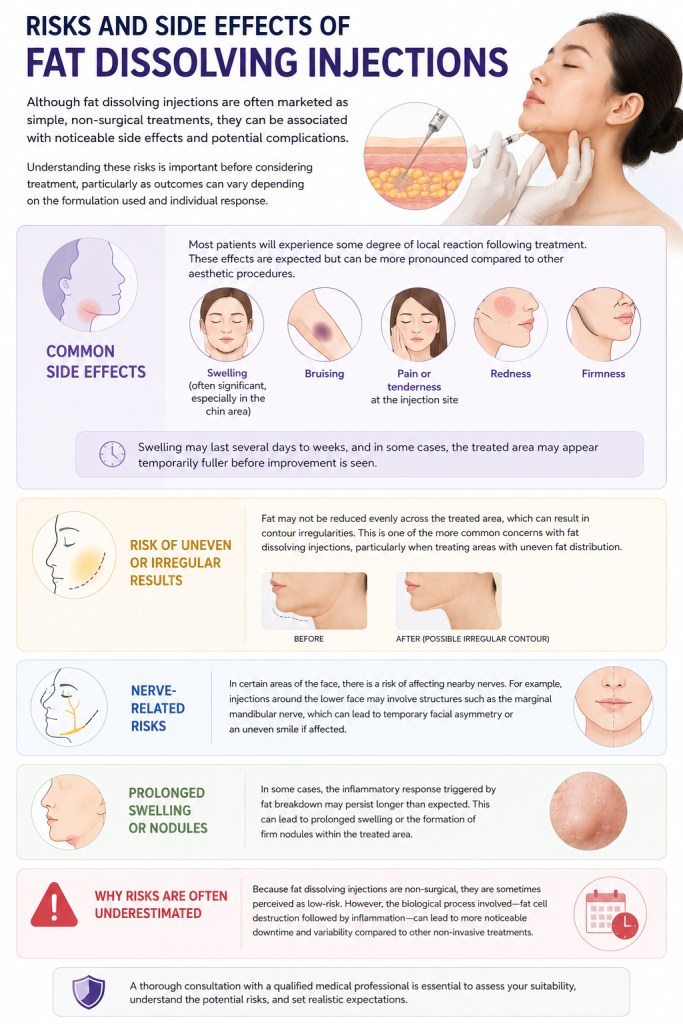
Although fat dissolving injections are often marketed as simple, non-surgical treatments, they can be associated with noticeable side effects and potential complications. Understanding these risks is important before considering treatment, particularly as outcomes can vary depending on the formulation used and individual response.

Common Side Effects

Most patients will experience some degree of local reaction following treatment. These effects are expected but can be more pronounced compared to other aesthetic procedures.

Common side effects include:

Swelling may last several days to weeks, and in some cases, the treated area may appear temporarily fuller before improvement is seen.

Risk of Uneven or Irregular Results

Fat may not be reduced evenly across the treated area, which can result in contour irregularities. This is one of the more common concerns with fat dissolving injections, particularly when treating areas with uneven fat distribution.

Nerve-Related Risks

In certain areas of the face, there is a risk of affecting nearby nerves. For example, injections around the lower face may involve structures such as the marginal mandibular nerve, which can lead to temporary facial asymmetry or an uneven smile if affected.

Prolonged Swelling or Nodules

In some cases, the inflammatory response triggered by fat breakdown may persist longer than expected. This can lead to prolonged swelling or the formation of firm nodules within the treated area.

Why Risks Are Often Underestimated

Because fat dissolving injections are non-surgical, they are sometimes perceived as low-risk. However, the biological process involved—fat cell destruction followed by inflammation—can lead to more noticeable downtime and variability compared to other non-invasive treatments.

Are Fat Dissolving Injections Effective?

Fat dissolving injections can produce visible fat reduction in selected cases, but their effectiveness is often limited and depends on the type of fat being treated. Understanding what these treatments can realistically achieve is important before deciding whether they are suitable.

When Fat Dissolving Injections May Work

Fat dissolving injections are most effective for small, well-defined fat deposits. Patients who tend to see better outcomes typically have:

In these cases, gradual reduction in fat thickness can lead to modest contour improvement over time.

When Fat Dissolving Injections Do Not Work Well

These treatments are less effective in many common scenarios, including:

In such cases, reducing a small amount of fat may not produce a noticeable or meaningful visual change.

Why Results Are Often Limited

Unlike surgical fat removal, fat dissolving injections work gradually and typically reduce only a limited amount of fat with each session.

Multiple sessions are usually required, and even then, the degree of improvement is often modest. Patients expecting significant slimming or dramatic fat reduction may find the results less noticeable than expected.

Importance of Setting Realistic Expectations

One of the most important factors in patient satisfaction is having realistic expectations before treatment.

Fat dissolving injections are designed for subtle contouring, not major fat reduction. A proper assessment is important to determine whether this approach is likely to provide meaningful improvement, or whether alternative treatments may be more suitable.

Alternatives to Fat Dissolving Injections in Singapore

Given the variability in results and the limited role of fat dissolving injections, many patients may benefit more from alternative treatments that offer more predictable outcomes. The most suitable approach depends on whether the concern is localised fat, skin laxity, or overall body fat.

Non-Surgical Fat Reduction Treatments

Non-invasive treatments can reduce localised fat without injections and are generally more standardised in terms of delivery and outcomes.

Options include:

Learn more about ultrasound-based lifting with HIFU:
Read more...

These treatments may provide more consistent and predictable results compared to fat dissolving injections, particularly for patients with small to moderate fat deposits.

Skin Tightening and Contouring Treatments

In some cases, what appears to be excess fat may instead be due to skin laxity or loss of structural support. Treatments that focus on lifting and tightening may produce more noticeable improvement than fat reduction alone.

Options include:

Addressing the underlying cause is key to achieving natural-looking and balanced results.

Medical Weight Loss Treatments

For patients with generalised fat or weight concerns, doctor-supervised medical weight loss treatments may be more effective than localised fat reduction approaches.

Learn more about Wegovy weight loss treatment in Singapore:
Read more...

Learn more about Mounjaro weight loss treatment in Singapore:
Read more...

These treatments work by regulating appetite and metabolism, leading to gradual fat reduction across the body rather than targeting a single area.

Liposuction for Larger Fat Reduction

For patients with larger or more significant fat deposits, surgical options such as liposuction may be considered. Liposuction physically removes fat cells and can produce more immediate and noticeable fat reduction compared to non-surgical treatments.

However, liposuction:

It is typically considered when non-surgical options are insufficient or when more significant fat reduction is desired.

Doctor’s Perspective – Who Is Suitable for Fat Dissolving Injections?

From a clinical perspective, fat dissolving injections have a limited but specific role in fat reduction. Careful patient selection is important, as outcomes can vary and the treatment is not suitable for all types of fat concerns.

Who May Be Suitable

Fat dissolving injections may be considered in patients with:

In these cases, treatment may lead to subtle contour enhancement rather than significant fat reduction.

Who Is Less Suitable

Many patients may not be ideal candidates for fat dissolving injections, particularly those with:

In such situations, alternative treatments are often more appropriate and provide more predictable outcomes.

Importance of Proper Assessment

One of the most common reasons for unsatisfactory results is incorrect assessment of the underlying concern. What appears to be fat may instead be due to:

A proper clinical assessment is important to determine whether fat dissolving injections are likely to provide meaningful improvement.

Frequently Asked Questions About Fat Dissolving Injections in Singapore

Patients researching fat dissolving injections often have questions about safety, effectiveness, and what results to expect. The answers below address common concerns based on clinical practice in Singapore.

Are Fat Dissolving Injections Approved In Singapore?

Fat dissolving injections are not widely standardised or commonly used as a routine aesthetic treatment in Singapore. While some formulations are approved overseas, their use locally must comply with guidelines set by the Ministry of Health (MOH) and Health Sciences Authority (HSA).

How Many Sessions Are Needed For Fat Dissolving Injections?

Most patients require multiple sessions to achieve visible results. Depending on the area treated and the amount of fat present, this typically ranges from 2 to 6 sessions spaced several weeks apart.

Are Results From Fat Dissolving Injections Permanent?

Fat cells that are destroyed do not regenerate. However, remaining fat cells in the area can still enlarge with weight gain, which may affect long-term results.

What Is The Downtime After Fat Dissolving Injections?

Swelling is common and can be significant, especially in areas such as the double chin. This may last several days to weeks before gradually improving. Bruising and tenderness may also occur.

Do Fat Dissolving Injections Work For Weight Loss?

Fat dissolving injections are not designed for weight loss. They only target small, localised fat deposits and do not reduce overall body fat. For generalised fat reduction, doctor-supervised weight loss treatments are more effective.

Why Do Results From Fat Dissolving Injections Vary So Much?

Results can vary due to differences in product formulation, treatment approach, and individual factors such as fat distribution and skin quality. This variability is one of the main limitations of fat dissolving injections.

Conclusion – Understanding Fat Reduction Options in Singapore

Fat dissolving injections can offer a non-surgical option for reducing small, localised fat deposits, but their outcomes are often variable and modest. They are not designed for significant fat reduction or weight loss and may not be suitable for many patients seeking more noticeable changes.

For many individuals, alternative treatments such as non-surgical fat reduction, skin tightening, or doctor-supervised medical weight loss may provide more predictable and clinically meaningful results. Choosing the right treatment depends on the underlying cause of the concern and individual treatment goals.

A personalised medical assessment is important to determine the most appropriate approach and to achieve safe, balanced, and natural-looking outcomes.

Book A Consultation

If you are considering fat dissolving injections or exploring alternative fat reduction treatments, a personalised medical assessment is important to determine the most appropriate approach for your concerns.

Each patient’s condition is different, and factors such as fat distribution, skin laxity, and overall goals need to be carefully evaluated before deciding on treatment.

You may contact us here to arrange a consultation:
Read more...

How Long Do You Need To Take GLP-1 Weight Loss Medication – Treatment Duration, Maintenance And Long-Term Planning In Singapore

One of the most common questions about GLP-1 weight loss treatment is how long therapy needs to continue. Many individuals want to know whether treatment is short term, whether it must be taken for years, and how doctors determine the appropriate duration. Understanding treatment length is an important part of setting realistic expectations and planning for long-term weight management.

GLP-1 receptor–based medications regulate appetite and metabolic balance through ongoing hormonal signalling. Because body weight is biologically regulated, treatment duration depends on individual response, weight goals, metabolic profile, and long-term maintenance strategy rather than a fixed number of weeks or months.

This guide explains how long GLP-1 weight loss medication is typically used, what clinical trials show about treatment duration, whether long-term therapy is necessary, and how doctor-supervised planning in Singapore helps determine the most appropriate timeline for sustained weight stability.

Is GLP-1 Weight Loss Treatment Short-Term Or Long-Term?

GLP-1 weight loss medication is generally considered part of a long-term weight management strategy rather than a short-term intervention. While some individuals may use treatment for several months, others may require longer durations depending on appetite regulation, metabolic response, and weight stability goals.

Unlike crash dieting approaches, GLP-1 therapy works by continuously regulating hunger and satiety pathways. Because excess body weight is often driven by persistent biological signals, stopping treatment too early may increase the likelihood of appetite return and gradual weight regain.

Treatment duration is therefore individualised rather than fixed. Doctors assess response over time and adjust plans based on weight trend, appetite control, and long-term sustainability.

Why Short-Term Use May Not Be Sufficient

Short-term use may initiate weight reduction, but appetite regulation and metabolic adaptation may not fully stabilise within a few weeks. Clinical trials evaluating GLP-1 receptor–based therapy typically assess outcomes over 68 weeks or longer, reflecting the chronic nature of weight management.

Abrupt discontinuation after a brief course may not allow sufficient time for sustainable behaviour and metabolic adjustments.

Viewing Obesity As A Chronic Condition

For many individuals, excess weight behaves like a chronic condition influenced by hormonal regulation, metabolic adaptation, and appetite signalling. Just as other chronic conditions require ongoing management, weight regulation may also require structured long-term planning.

GLP-1 therapy is often integrated into a broader long-term strategy rather than treated as a temporary solution.

What Do Clinical Trials Show About Treatment Duration?

Clinical trials evaluating GLP-1 weight loss medications have typically studied outcomes over extended periods rather than short treatment courses. Major randomised controlled trials assessing GLP-1 receptor–based therapy have followed participants for approximately 68 weeks or longer, reflecting the need for sustained hormonal regulation to achieve and maintain meaningful weight reduction.

These longer study durations highlight an important principle: weight management is not a short-term intervention. Appetite regulation, metabolic adaptation, and behavioural reinforcement develop progressively over months rather than weeks.

Duration In Major GLP-1 Trials

In large clinical trial programmes evaluating semaglutide-based therapy, participants remained on treatment for over one year. Weight reduction was progressive during the early months and stabilised with continued therapy.

Sustained treatment was associated with maintenance of weight loss during the active treatment phase.

For more information about GLP-1 receptor–based therapy, you may read here:
Read more...

What Happens When Treatment Continues

Clinical evidence suggests that ongoing therapy helps maintain appetite regulation and weight stability during the treatment period. When hormonal signalling remains active, hunger control is more consistent and long-term weight reduction is more sustainable.

This reinforces the concept that GLP-1 therapy supports weight management through continued biological regulation rather than short bursts of appetite suppression.

Why Trial Duration Matters

Trial duration reflects how obesity is treated medically — as a chronic condition requiring sustained management. Short-term courses may initiate weight reduction, but meaningful long-term stability typically requires continued monitoring and structured planning.

Understanding clinical trial duration helps patients set realistic expectations about how long treatment may need to continue to achieve and maintain results.

What Do Clinical Trials Show About Treatment Duration?

Clinical trials evaluating GLP-1 weight loss medications have typically studied outcomes over extended periods rather than short treatment courses. Major randomised controlled trials assessing GLP-1 receptor–based therapy have followed participants for approximately 68 weeks or longer, reflecting the need for sustained hormonal regulation to achieve and maintain meaningful weight reduction.

These longer study durations highlight an important principle: weight management is not a short-term intervention. Appetite regulation, metabolic adaptation, and behavioural reinforcement develop progressively over months rather than weeks.

Duration In Major GLP-1 Trials

In large clinical trial programmes evaluating semaglutide-based therapy, participants remained on treatment for over one year. Weight reduction was progressive during the early months and stabilised with continued therapy.

Sustained treatment was associated with maintenance of weight loss during the active treatment phase.

For more information about GLP-1 receptor–based therapy, you may read here:
Read more...

What Happens When Treatment Continues

Clinical evidence suggests that ongoing therapy helps maintain appetite regulation and weight stability during the treatment period. When hormonal signalling remains active, hunger control is more consistent and long-term weight reduction is more sustainable.

This reinforces the concept that GLP-1 therapy supports weight management through continued biological regulation rather than short bursts of appetite suppression.

Why Trial Duration Matters

Trial duration reflects how obesity is treated medically — as a chronic condition requiring sustained management. Short-term courses may initiate weight reduction, but meaningful long-term stability typically requires continued monitoring and structured planning.

Understanding clinical trial duration helps patients set realistic expectations about how long treatment may need to continue to achieve and maintain results.

How Doctors Decide The Right Duration Of Treatment

The appropriate duration of GLP-1 weight loss therapy is determined through structured clinical assessment rather than a fixed timeline. Doctors evaluate weight trend, appetite regulation, metabolic profile, treatment tolerance, and long-term goals before recommending continuation, adjustment, or discontinuation.

Because body weight is biologically regulated, treatment duration must account for both initial fat reduction and long-term stability. The decision is based on clinical response rather than arbitrary treatment length.

Assessment Of Weight Trend And Stability

Doctors review the pattern of weight reduction over time. Steady, progressive fat loss followed by stabilisation may indicate readiness for maintenance planning.

If weight remains unstable or appetite dysregulation persists, extended treatment may be considered to support long-term control.

Evaluation Of Appetite Regulation

Sustained appetite control is a key marker of readiness for dose adjustment or discontinuation. If hunger remains well-regulated and eating patterns are stable, gradual transition may be appropriate.

If strong hunger signals return quickly, longer duration or maintenance dosing may be advisable.

Metabolic And Clinical Profile

Baseline BMI, metabolic resistance, history of weight cycling, and overall health profile influence recommended treatment duration. Individuals with higher metabolic risk may benefit from longer structured therapy.

Clinical judgement ensures treatment duration aligns with long-term health priorities.

Structured Monitoring During Transition

When dose reduction or discontinuation is considered, structured follow-up helps monitor weight trends and appetite changes. Early detection of weight regain allows timely intervention.

For an overview of doctor-supervised medical weight loss treatment, you may read here:
Read more...

Minimum Recommended Duration For Meaningful Results

GLP-1 weight loss therapy is not designed as a short-term intervention lasting only a few weeks. Meaningful and sustainable fat reduction typically develops progressively over several months as appetite regulation stabilises and metabolic adaptation occurs.

While individual response varies, most clinical trials evaluating GLP-1 receptor–based therapy assess outcomes over approximately 6 to 12 months or longer. This reflects the biological reality that appetite pathways and body weight regulation require time to adjust.

Early Phase (First 1–3 Months)

During the first few months, treatment usually follows a gradual dose escalation schedule. Appetite regulation may begin early, but maximum therapeutic effect often develops after reaching maintenance dosing.

Weight reduction in this phase is typically steady but may not yet reflect full potential outcomes.

Intermediate Phase (3–6 Months)

By three to six months, appetite suppression and eating pattern stabilisation are usually more consistent. Many individuals achieve clinically meaningful percentage-based weight reduction during this period.

This phase often determines whether treatment is effective and well tolerated.

Longer-Term Phase (6–12 Months And Beyond)

Clinical evidence suggests that sustained treatment beyond six months allows continued fat reduction or weight stabilisation. Longer duration supports behavioural reinforcement, metabolic adjustment, and appetite regulation consolidation.

Stopping too early may not allow sufficient time for stable long-term weight maintenance to develop.

For more information about expected weight loss results over time, you may read here:
Read more...

When Is It Appropriate To Consider Stopping GLP-1 Weight Loss Medication?

Deciding when to stop GLP-1 weight loss medication should be guided by clinical assessment rather than a predetermined timeline. Treatment discontinuation is typically considered only after weight goals have been achieved, appetite regulation has stabilised, and long-term maintenance strategies are in place.

Stopping too early may increase the risk of appetite rebound and gradual weight regain. Careful evaluation helps determine whether biological appetite signals remain stable without ongoing hormonal support.

Achievement Of Target Weight And Stability

Discontinuation may be considered once target weight has been reached and maintained consistently over time. Stable weight trend without ongoing rapid fluctuations suggests improved appetite control and behavioural consolidation.

Sustained stability over several months is generally more reassuring than short-term weight achievement.

Consistent Appetite Regulation Without Escalation

If hunger levels remain controlled and eating patterns are structured without requiring further dose increases, gradual dose reduction may be discussed.

Persistent appetite dysregulation, frequent cravings, or rising hunger signals may indicate the need for continued therapy or maintenance dosing.

Absence Of Ongoing Metabolic Instability

Individuals with significant metabolic resistance or repeated weight cycling may benefit from longer-term structured therapy.

Discontinuation may be more appropriate when metabolic parameters, appetite control, and weight stability demonstrate consistent improvement.

Gradual Transition Rather Than Abrupt Cessation

In some cases, gradual dose reduction may allow smoother adjustment compared to abrupt stopping. Structured monitoring during transition helps detect early appetite return or weight increase.

For detailed information about what happens after stopping GLP-1 therapy, you may read here:
Read more...

Frequently Asked Questions About GLP-1 Treatment Duration

How Long Should I Take GLP-1 Weight Loss Medication?

There is no fixed duration that applies to everyone. Most individuals remain on GLP-1 therapy for several months to over a year, depending on weight goals, appetite regulation, and metabolic response.

Treatment duration is individualised and guided by medical assessment rather than a predetermined timeframe.

Can I Stop GLP-1 After Three Months?

Stopping after three months may be possible in selected cases, but this is often early in the treatment process. Maximum appetite regulation and meaningful percentage-based weight reduction usually develop over longer durations.

Early discontinuation may increase the likelihood of appetite return and gradual weight regain.

Do I Need To Take GLP-1 Forever?

Not necessarily. Some individuals may transition off treatment after achieving stable weight and appetite control. Others may require longer-term therapy or maintenance dosing depending on biological response and weight history.

GLP-1 treatment is best viewed as part of structured long-term weight management rather than a short-term intervention.

What Is The Minimum Duration For Effective Results?

Clinical trials evaluating GLP-1 receptor–based therapy typically assess outcomes over 6 to 12 months or longer. This reflects the time required for sustained appetite regulation and metabolic adjustment.

Shorter durations may initiate weight loss but may not allow full stabilisation.

Is Long-Term GLP-1 Use Safe?

GLP-1–based medications have been evaluated in large clinical trials with extended follow-up periods. Long-term use should always be supervised medically to ensure appropriate dosing, monitoring, and assessment of tolerability.

Safety depends on individual health profile and structured follow-up.

How Do Doctors Decide When To Reduce The Dose?

Doctors assess weight stability, appetite regulation, metabolic profile, and treatment tolerance. If appetite remains controlled and weight is stable, gradual dose adjustment may be considered.

Structured monitoring helps guide safe transition decisions.

How GIP Works In Weight Loss – Mechanism Of Action, Metabolic Effects And Its Role In Dual-Pathway Therapy Explained

GIP, or glucose-dependent insulinotropic polypeptide, is a naturally occurring incretin hormone released from the small intestine after meals. Although it was historically discussed mainly in the context of insulin secretion, GIP has become increasingly important in modern obesity medicine because of its potential influence on appetite regulation, insulin dynamics, and energy balance when combined with GLP-1 signalling.

Understanding how GIP works helps explain why dual-pathway therapy (GLP-1/GIP) is biologically different from GLP-1-only treatment. GIP receptors are present in multiple tissues involved in metabolism, including the pancreas and adipose tissue, and GIP signalling interacts with post-meal hormonal pathways that influence glucose control and overall energy regulation.

This guide explains what GIP is, where it acts in the body, how it affects insulin and metabolism, how it may influence appetite and fat regulation, and why GIP is paired with GLP-1 in dual-pathway weight loss treatment.

For an overview of dual-pathway weight loss therapy, you may also read here:
Read more...

What Is GIP And Why Is It Called An Incretin Hormone

GIP, or glucose-dependent insulinotropic polypeptide, is a naturally occurring incretin hormone released from specialised K-cells in the small intestine shortly after food intake. It is one of the body’s key post-meal signalling hormones and plays an important role in coordinating insulin secretion and metabolic regulation.

The term “incretin” refers to hormones that enhance insulin secretion in response to oral nutrient intake. When carbohydrates or fats are consumed, GIP is released into the bloodstream and signals the pancreas to increase insulin production in a glucose-dependent manner. This helps maintain stable blood glucose levels after meals.

Although GIP was initially studied primarily for its effects on insulin secretion, more recent research has identified broader roles in energy balance, adipose tissue regulation, and metabolic signalling. These additional effects have made GIP a significant target in modern dual-pathway weight loss therapy.

Where GIP Is Produced

GIP is produced in the upper small intestine, particularly in the duodenum and jejunum. It is released rapidly after food enters the digestive tract, especially in response to carbohydrates and fats.

Once released, GIP travels through the bloodstream to act on various tissues involved in metabolic control.

GIP Receptor Distribution In The Body

GIP receptors are found in several metabolically active tissues, including:

This distribution explains why GIP influences not only insulin secretion but also broader aspects of energy regulation.

How Natural GIP Functions After A Meal

After eating, GIP helps coordinate the body’s metabolic response by:

Under normal physiological conditions, GIP works together with GLP-1 as part of the incretin system to maintain glucose balance.

How GIP Influences Insulin Secretion And Glucose Regulation

One of the primary physiological roles of GIP is to enhance glucose-dependent insulin secretion after meals. When blood glucose levels rise following carbohydrate intake, GIP signals pancreatic beta cells to release insulin in proportion to the degree of glucose elevation.

This glucose-dependent mechanism is important because it prevents excessive insulin release during fasting states while supporting appropriate post-meal glucose control. In healthy physiology, GIP works alongside GLP-1 to optimise insulin response and maintain metabolic balance.

Glucose-Dependent Insulinotropic Effect

GIP enhances insulin secretion only when blood glucose levels are elevated. This ensures that insulin release is aligned with nutrient intake rather than occurring independently of metabolic need.

This targeted response supports post-prandial glucose control without triggering inappropriate insulin activity during fasting.

Interaction With GLP-1 In The Incretin System

GIP and GLP-1 are both incretin hormones, but they act through separate receptors. Together, they amplify insulin secretion in response to meals.

In individuals with obesity or metabolic dysregulation, the responsiveness of the GIP pathway may be altered. This has led to research exploring how modulating GIP signalling in combination with GLP-1 activation may improve metabolic regulation.

Role In Post-Meal Energy Regulation

Beyond insulin secretion, GIP participates in coordinating how nutrients are processed and stored after eating. This includes influencing how the body handles glucose and lipids in the immediate post-meal period.

These metabolic roles help explain why GIP has become an area of interest in dual-pathway weight loss therapy rather than being viewed solely as an insulin-related hormone.

For a broader explanation of GLP-1 physiology and appetite regulation, you may read here:
https://weightlossclinic.sg/how-glp-1-weight-loss-medications-work/

How GIP Influences Insulin Secretion And Glucose Regulation

One of the primary physiological roles of GIP is to enhance glucose-dependent insulin secretion after meals. When blood glucose levels rise following carbohydrate intake, GIP signals pancreatic beta cells to release insulin in proportion to the degree of glucose elevation.

This glucose-dependent mechanism is important because it prevents excessive insulin release during fasting states while supporting appropriate post-meal glucose control. In healthy physiology, GIP works alongside GLP-1 to optimise insulin response and maintain metabolic balance.

Glucose-Dependent Insulinotropic Effect

GIP enhances insulin secretion only when blood glucose levels are elevated. This ensures that insulin release is aligned with nutrient intake rather than occurring independently of metabolic need.

This targeted response supports post-prandial glucose control without triggering inappropriate insulin activity during fasting.

Interaction With GLP-1 In The Incretin System

GIP and GLP-1 are both incretin hormones, but they act through separate receptors. Together, they amplify insulin secretion in response to meals.

In individuals with obesity or metabolic dysregulation, the responsiveness of the GIP pathway may be altered. This has led to research exploring how modulating GIP signalling in combination with GLP-1 activation may improve metabolic regulation.

Role In Post-Meal Energy Regulation

Beyond insulin secretion, GIP participates in coordinating how nutrients are processed and stored after eating. This includes influencing how the body handles glucose and lipids in the immediate post-meal period.

These metabolic roles help explain why GIP has become an area of interest in dual-pathway weight loss therapy rather than being viewed solely as an insulin-related hormone.

For a broader explanation of GLP-1 physiology and appetite regulation, you may read here:
https://weightlossclinic.sg/how-glp-1-weight-loss-medications-work/

How GIP Works In Dual-Pathway GLP-1/GIP Therapy

Dual-pathway weight loss therapy activates both the GLP-1 receptor and the GIP receptor simultaneously. Rather than replacing GLP-1 signalling, GIP receptor activation builds upon it, creating broader hormonal modulation across appetite regulation, insulin dynamics, and energy balance.

GLP-1 primarily drives appetite suppression, delayed gastric emptying, and glucose-dependent insulin regulation. GIP receptor activation appears to enhance metabolic signalling through complementary pathways, potentially influencing insulin sensitivity, adipose tissue regulation, and central appetite modulation.

The combined effect may produce greater overall appetite stability and higher average percentage-based weight reduction compared to single-pathway therapy in certain individuals.

Complementary Incretin Signalling

GLP-1 and GIP are both incretin hormones, but they act through distinct receptors. When activated together, they influence overlapping yet complementary metabolic pathways.

This dual receptor activation may:

The goal is not stronger appetite suppression alone, but broader metabolic coordination.

Clinical Evidence Supporting Dual-Pathway Therapy

Large clinical trial programmes evaluating dual GLP-1/GIP receptor activation have demonstrated significant average weight reduction over extended study periods. These outcomes suggest that engaging multiple incretin pathways may improve treatment response in selected individuals.

For more information about dual-pathway injectable therapy in Singapore, you may read here:
Read more...

Individual Response Still Varies

Despite promising clinical results, response to dual-pathway therapy varies between individuals. Factors such as baseline BMI, appetite dysregulation severity, metabolic resistance, and treatment tolerance influence outcomes.

Medical assessment helps determine whether single-pathway GLP-1 therapy or dual-pathway GLP-1/GIP therapy is more suitable.

Is GIP Safe In Weight Loss Therapy?

GIP receptor activation in dual-pathway weight loss therapy has been evaluated in large, well-designed clinical trials involving adults with overweight and obesity. Safety assessment includes monitoring of gastrointestinal tolerance, metabolic markers, and overall clinical profile throughout extended study durations.

Because GIP works within the body’s natural incretin system, its activation in combination with GLP-1 builds upon existing physiological pathways rather than introducing a completely foreign mechanism. However, as with any prescription therapy, safety depends on appropriate patient selection, gradual dose escalation, and structured medical supervision.

Clinical Trial Safety Data

In major dual-pathway trial programmes, safety profiles were evaluated over approximately 72 weeks. The most commonly observed effects were gastrointestinal in nature, similar to GLP-1 receptor–based therapy.

Adverse events were generally dose-dependent and occurred more frequently during the early dose-escalation phase. Careful titration helps improve tolerability.

Importance Of Dose Escalation

Gradual dose escalation allows the body to adapt to incretin signalling changes. This reduces the likelihood of significant gastrointestinal discomfort and improves overall tolerability.

Medical supervision ensures that dosing adjustments are made based on individual tolerance and clinical response.

Who May Not Be Suitable

Suitability for dual-pathway therapy depends on medical history, metabolic profile, and individual risk factors. Structured clinical assessment helps determine whether GLP-1–only therapy or GLP-1/GIP dual-pathway therapy is appropriate.

For a broader overview of GLP-1 safety and mechanism, you may read here:
https://weightlossclinic.sg/how-glp-1-weight-loss-medications-work/

GIP Vs GLP-1 – Key Mechanistic Differences At A Glance

Although both GIP and GLP-1 are incretin hormones involved in post-meal metabolic regulation, they differ in receptor targets, primary physiological roles, and appetite effects. Understanding these differences helps clarify why dual-pathway therapy engages both systems.

Mechanism Comparison Summary

FeatureGLP-1GIP
Hormone TypeIncretin hormoneIncretin hormone
Primary SourceL-cells in small intestineK-cells in small intestine
Main Receptor TargetGLP-1 receptorGIP receptor
Primary Appetite EffectDirect appetite suppression via hypothalamusIndirect modulation when combined with GLP-1
Effect On Gastric EmptyingSlows gastric emptyingMinimal direct effect
Insulin RegulationEnhances glucose-dependent insulin secretionEnhances glucose-dependent insulin secretion
Effect On GlucagonSuppresses glucagonLess pronounced glucagon suppression
Role In Fat MetabolismIndirect via appetite reductionMay influence adipose tissue signalling
Clinical Use In Weight LossSingle-pathway therapyUsed in combination with GLP-1 in dual-pathway therapy

Why Dual-Pathway Activation May Enhance Results

GLP-1 primarily regulates appetite and slows digestion, leading to reduced calorie intake. GIP contributes to complementary metabolic signalling, particularly in insulin dynamics and adipose tissue pathways.

Together, dual receptor activation may provide broader metabolic regulation compared to GLP-1 alone in selected individuals.

For a direct comparison of single-pathway and dual-pathway therapy, you may read here:
Read more...

Frequently Asked Questions About GIP In Weight Loss

What Is GIP Hormone?

GIP, or glucose-dependent insulinotropic polypeptide, is a naturally occurring incretin hormone released from the small intestine after meals. It enhances glucose-dependent insulin secretion and plays a role in post-meal metabolic regulation.

It works alongside GLP-1 as part of the body’s incretin system.

Does GIP Suppress Appetite?

GIP alone does not produce strong appetite suppression in the same way as GLP-1. However, when GIP receptor activation is combined with GLP-1 receptor activation in dual-pathway therapy, complementary hormonal signalling may enhance overall appetite regulation.

The primary appetite-suppressing effect in weight loss treatment is still driven by GLP-1 signalling.

How Does GIP Help With Weight Loss?

In dual-pathway therapy, GIP receptor activation contributes to broader metabolic regulation. This may include improved insulin dynamics, potential effects on adipose tissue signalling, and enhanced coordination with GLP-1–mediated appetite control.

The combination of GLP-1 and GIP receptor activation may support greater percentage-based weight reduction in selected individuals.

What Is The Difference Between GLP-1 And GIP?

Both GLP-1 and GIP are incretin hormones released after meals. GLP-1 has a stronger and more direct role in appetite suppression and gastric emptying, while GIP primarily influences insulin secretion and metabolic signalling.

Dual-pathway therapy activates both receptors to broaden hormonal regulation.

Is GIP Therapy Safe?

GIP receptor activation as part of dual-pathway therapy has been evaluated in large clinical trials. Safety depends on appropriate patient selection, gradual dose escalation, and structured medical supervision.

Ongoing monitoring ensures treatment remains suitable and well tolerated.

Is GIP Used Alone For Weight Loss?

Currently, GIP is not used as a standalone weight loss therapy. Its therapeutic role in obesity management is in combination with GLP-1 receptor activation as part of dual-pathway treatment.

For more information about GLP-1–based therapy, you may read here:
Read more...

How GLP-1 Weight Loss Medications Work – Mechanism Of Action, Appetite Regulation And Metabolic Effects Explained

GLP-1 weight loss medications have transformed the medical management of overweight and obesity by targeting the biological pathways that regulate appetite, satiety, and energy balance. Rather than relying solely on calorie restriction or willpower, these treatments work by influencing incretin hormones that control hunger signals in the brain and metabolic responses in the body.

Understanding the mechanism of action of GLP-1 therapy helps explain why these medications can produce sustained percentage-based weight reduction in suitable individuals. By acting on appetite centres in the brain, slowing gastric emptying, and improving insulin regulation, GLP-1–based therapy addresses the physiological drivers of weight gain.

This guide explains how GLP-1 works in the body, how it regulates appetite and metabolism, how it leads to fat reduction, and why doctor-supervised treatment is important for safe and effective long-term weight management in Singapore.

What Is GLP-1

GLP-1, or glucagon-like peptide-1, is a naturally occurring incretin hormone released from specialised cells in the small intestine after food intake. It plays a central role in regulating appetite, insulin secretion, gastric emptying, and overall energy balance.

GLP-1 is part of the body’s normal physiological response to eating. When food enters the digestive tract, GLP-1 is secreted into the bloodstream and travels to multiple organs, including the pancreas, stomach, and brain. Through these pathways, it helps coordinate hunger signals, glucose regulation, and satiety.

Because of its key role in appetite and metabolic regulation, GLP-1 has become a primary therapeutic target in modern medical weight loss treatment.

GLP-1 As An Incretin Hormone

GLP-1 belongs to a group of hormones known as incretins. Incretins are released after meals and enhance glucose-dependent insulin secretion. This means insulin is released more effectively when blood sugar rises after eating.

This glucose-dependent mechanism helps stabilise blood sugar levels while reducing the risk of excessive insulin release during fasting states.

Where GLP-1 Receptors Are Located

GLP-1 receptors are found in several key areas involved in appetite and metabolic regulation:

The wide distribution of GLP-1 receptors explains why activation of this pathway influences both appetite and metabolic function.

Why Natural GLP-1 Alone Is Not Enough For Weight Loss

Although GLP-1 is naturally produced after meals, it is rapidly broken down in the body within minutes. This short duration limits its ability to produce sustained appetite suppression.

GLP-1 receptor–based medications are designed to mimic and prolong the action of natural GLP-1, allowing continuous appetite regulation and metabolic support over extended periods.

For more information about GLP-1 receptor–based therapy used in medical weight loss, you may read here:
Read more...

How GLP-1 Regulates Appetite In The Brain

One of the primary mechanisms through which GLP-1 weight loss medications promote fat reduction is by acting on appetite-regulating centres in the brain. Hunger and satiety are not controlled by willpower alone but by complex neurohormonal pathways that influence food intake and energy balance.

GLP-1 receptors are highly expressed in the hypothalamus and brainstem, areas responsible for regulating appetite, fullness, and energy expenditure. When these receptors are activated, signals that promote satiety are enhanced, while hunger signals are reduced.

This central appetite regulation is a key reason why GLP-1–based therapy can produce sustained calorie reduction without extreme dietary restriction.

Effects On The Hypothalamus

The hypothalamus integrates signals related to hunger, energy stores, and nutrient availability. Activation of GLP-1 receptors within this region influences neurons involved in satiety signalling.

This leads to:

By modulating hypothalamic pathways, GLP-1 therapy helps reset appetite regulation toward a lower calorie balance.

Reduction Of Food Reward Signalling

GLP-1 receptor activation may also influence reward-related areas of the brain, reducing the reinforcing effect of highly palatable foods. Some individuals report reduced cravings for calorie-dense foods during treatment.

This effect supports behavioural adherence by reducing the intensity of hunger-driven impulses.

Sustained Satiety Rather Than Forced Restriction

Unlike strict dieting, which relies on conscious calorie restriction, GLP-1 therapy works by biologically enhancing satiety signals. Individuals often feel satisfied with smaller portions rather than feeling deprived.

This physiological appetite regulation helps maintain a consistent calorie deficit over time, supporting gradual fat reduction.

How GLP-1 Regulates Appetite In The Brain

One of the primary mechanisms through which GLP-1 weight loss medications promote fat reduction is by acting on appetite-regulating centres in the brain. Hunger and satiety are not controlled by willpower alone but by complex neurohormonal pathways that influence food intake and energy balance.

GLP-1 receptors are highly expressed in the hypothalamus and brainstem, areas responsible for regulating appetite, fullness, and energy expenditure. When these receptors are activated, signals that promote satiety are enhanced, while hunger signals are reduced.

This central appetite regulation is a key reason why GLP-1–based therapy can produce sustained calorie reduction without extreme dietary restriction.

Effects On The Hypothalamus

The hypothalamus integrates signals related to hunger, energy stores, and nutrient availability. Activation of GLP-1 receptors within this region influences neurons involved in satiety signalling.

This leads to:

By modulating hypothalamic pathways, GLP-1 therapy helps reset appetite regulation toward a lower calorie balance.

Reduction Of Food Reward Signalling

GLP-1 receptor activation may also influence reward-related areas of the brain, reducing the reinforcing effect of highly palatable foods. Some individuals report reduced cravings for calorie-dense foods during treatment.

This effect supports behavioural adherence by reducing the intensity of hunger-driven impulses.

Sustained Satiety Rather Than Forced Restriction

Unlike strict dieting, which relies on conscious calorie restriction, GLP-1 therapy works by biologically enhancing satiety signals. Individuals often feel satisfied with smaller portions rather than feeling deprived.

This physiological appetite regulation helps maintain a consistent calorie deficit over time, supporting gradual fat reduction.

How GLP-1 Influences Insulin And Metabolic Regulation

Beyond appetite suppression and slowed gastric emptying, GLP-1 plays an important role in regulating insulin secretion and overall metabolic balance. These metabolic effects contribute to improved energy utilisation and may indirectly support sustained fat reduction.

GLP-1 enhances glucose-dependent insulin secretion from pancreatic beta cells. This means insulin release increases appropriately after meals when blood glucose levels rise, helping maintain stable glucose control. At the same time, GLP-1 suppresses glucagon secretion, reducing unnecessary glucose production by the liver.

Together, these effects improve glycaemic stability and metabolic efficiency.

Glucose-Dependent Insulin Secretion

Unlike medications that stimulate insulin regardless of blood sugar levels, GLP-1 works in a glucose-dependent manner. Insulin secretion increases only when glucose is elevated after meals.

This targeted response helps improve metabolic regulation while reducing the risk of excessive insulin release during fasting states.

Reduction Of Glucagon Secretion

GLP-1 suppresses glucagon, a hormone that increases glucose production by the liver. Lower glucagon levels help prevent unnecessary elevation of blood sugar, particularly after meals.

Balanced insulin and glucagon signalling supports more stable metabolic control.

Indirect Effects On Fat Metabolism

Improved insulin sensitivity and metabolic stability may support more efficient utilisation of stored energy. While weight loss is primarily driven by appetite regulation and calorie reduction, improved metabolic balance contributes to sustained fat reduction over time.

GLP-1–based therapy therefore influences both behavioural appetite control and physiological metabolic regulation, creating a coordinated approach to weight management.

Why GLP-1 Leads To Sustained Weight Loss

Sustained weight loss requires a consistent energy deficit over time. What makes GLP-1 weight loss medications effective is that they influence multiple biological pathways simultaneously — appetite regulation in the brain, gastric emptying in the gut, and metabolic control in the pancreas and liver.

Rather than relying on conscious restriction alone, GLP-1 therapy reduces calorie intake through physiological satiety enhancement. Individuals often report feeling satisfied with smaller portions and experiencing fewer hunger-driven impulses. This makes long-term adherence more achievable compared to strict dieting.

Reduction In Total Calorie Intake

The primary driver of weight loss with GLP-1 therapy is reduced energy intake. By enhancing fullness and reducing hunger intensity, overall daily calorie consumption naturally decreases.

Over weeks and months, this sustained calorie deficit leads to gradual fat reduction.

Improved Appetite Consistency

One of the challenges of weight loss is fluctuating hunger levels. GLP-1–based therapy helps stabilise appetite signals, reducing the cycle of extreme hunger followed by overeating.

More predictable appetite regulation supports consistent eating patterns and improves long-term sustainability.

Counteracting Biological Weight Regain Signals

After weight loss occurs, the body often increases hunger hormones and lowers energy expenditure to defend previous fat stores. By continuing to regulate appetite pathways, GLP-1 therapy may help counteract some of these biological compensation mechanisms.

This is why GLP-1–based treatment is often considered part of long-term weight management rather than a short-term intervention.

For a deeper discussion on effectiveness and clinical outcomes, you may read here:
Read more...

Why Doctor Supervision Matters In GLP-1 Treatment

Although GLP-1 weight loss medications work through well-established biological mechanisms, safe and effective outcomes depend on appropriate patient selection, dose titration, and ongoing monitoring. Medical supervision ensures that treatment is tailored to individual metabolic profile, weight goals, and tolerability.

GLP-1 therapy is not a one-size-fits-all solution. Factors such as baseline BMI, appetite dysregulation severity, previous weight loss attempts, metabolic health, and medical history influence suitability and expected response. Structured clinical assessment helps determine whether GLP-1 receptor–based treatment is appropriate and how it should be implemented.

Proper Dose Escalation

GLP-1–based medications typically follow a gradual dose escalation schedule. Slow titration allows the body to adapt to appetite and gastrointestinal effects while reducing the likelihood of significant discomfort.

Doctor supervision ensures that dose increases are timed appropriately based on individual tolerance and response.

Monitoring Effectiveness And Tolerability

Regular follow-up allows assessment of appetite control, weight trend, side effects, and metabolic markers. Monitoring helps identify early plateau, inadequate appetite suppression, or tolerability concerns that may require adjustment.

Ongoing supervision supports sustained weight reduction while maintaining safety.

Long-Term Weight Management Planning

Because body weight is biologically regulated, long-term planning is often necessary to maintain results achieved during treatment. Medical guidance helps determine whether continued therapy, maintenance dosing, or structured lifestyle reinforcement is most appropriate.

For an overview of doctor-supervised medical weight loss treatment options, you may read here:
Read more...

If you are considering GLP-1 weight loss treatment in Singapore, a personalised consultation helps determine suitability and long-term strategy:
Read more...

Frequently Asked Questions About How GLP-1 Works

How Does GLP-1 Cause Weight Loss

GLP-1 weight loss medications promote fat reduction primarily by regulating appetite. They activate receptors in the brain that enhance satiety and reduce hunger intensity, leading to lower calorie intake over time.

In addition, GLP-1 slows gastric emptying and improves insulin regulation, supporting metabolic stability. Sustained calorie reduction is the main driver of gradual weight loss.

Does GLP-1 Suppress Appetite

Yes. GLP-1 enhances satiety signals in the hypothalamus and brainstem, reducing hunger intensity and portion size. Many individuals report feeling full sooner and experiencing fewer food cravings during treatment.
This appetite regulation is biological rather than purely behavioural.

Does GLP-1 Burn Fat Directly

GLP-1 does not directly “burn” fat. Instead, it reduces calorie intake through appetite regulation. When energy intake is consistently lower than energy expenditure, the body utilises stored fat for energy, resulting in gradual fat reduction.

Weight loss occurs through sustained energy deficit rather than direct fat-burning stimulation.

How Quickly Does GLP-1 Start Working

Appetite changes may be noticeable within the first few weeks of treatment. However, meaningful weight reduction typically develops gradually over several months as appetite regulation stabilises and calorie intake remains consistently reduced.

Dose escalation and individual metabolic profile influence the rate of response.

Is GLP-1 A Natural Hormone

Yes. GLP-1 is a naturally occurring incretin hormone released from the intestine after meals. GLP-1–based medications mimic and prolong the action of this natural hormone, allowing sustained appetite regulation beyond the short duration of naturally secreted GLP-1.

Why Is Natural GLP-1 Not Enough For Weight Loss

Natural GLP-1 is rapidly broken down within minutes after release. This short duration limits its ability to provide sustained appetite suppression.

GLP-1 receptor–based medications are designed to extend this effect, allowing continuous appetite regulation throughout the week when administered appropriately.

Is GLP-1 Safe For Long-Term Use

GLP-1 receptor–based therapy has been evaluated in large clinical trials for weight management. Long-term use should always be guided by medical supervision to ensure appropriate dosing, monitoring, and assessment of tolerability.

Safety depends on individual medical profile and structured follow-up.

Does GLP-1 Affect Metabolism

Yes. GLP-1 enhances glucose-dependent insulin secretion and suppresses glucagon release, improving metabolic stability. While appetite reduction is the primary driver of weight loss, improved metabolic regulation supports sustained energy balance over time.

GLP-1 Vs GLP-1/GIP Dual-Pathway Weight Loss Therapy – Differences In Mechanism, Effectiveness And Appetite Regulation

Many individuals researching injectable medical weight loss treatment encounter two primary hormonal approaches: GLP-1 receptor–based therapy and GLP-1/GIP dual-pathway therapy. While both are designed to support weight reduction through appetite regulation and metabolic control, they work through different biological mechanisms.

GLP-1 therapy activates the glucagon-like peptide-1 receptor to enhance satiety, reduce hunger signals, and slow gastric emptying. This helps create a sustained calorie deficit by improving portion control and reducing cravings.

Dual-pathway therapy activates both the GLP-1 receptor and the GIP (glucose-dependent insulinotropic polypeptide) receptor. By influencing two complementary incretin hormones, this approach affects appetite regulation, insulin signalling, and energy balance through multiple pathways.

Understanding the scientific differences between GLP-1 and GLP-1/GIP dual-pathway therapy helps patients make informed decisions based on physiology and clinical evidence rather than marketing claims.

This guide explains how each pathway works, how they differ at the hormonal level, what clinical trials demonstrate regarding effectiveness, and how doctor-supervised assessment in Singapore helps determine which approach may be more suitable for individual weight management goals.

What Is GLP-1 And How Does It Regulate Appetite

GLP-1, or glucagon-like peptide-1, is a naturally occurring incretin hormone released from the gut after food intake. It plays a key role in regulating appetite, insulin secretion, gastric emptying, and overall energy balance. Because of its central role in hunger signalling, GLP-1 has become a primary target in modern medical weight loss therapy.

GLP-1 receptors are found in multiple areas of the body, including the pancreas, stomach, and central nervous system. When activated, these receptors influence satiety pathways in the brain and slow the movement of food from the stomach into the small intestine. Together, these effects help reduce overall calorie intake.

GLP-1 And Appetite Regulation In The Brain

GLP-1 acts on appetite-regulating centres in the hypothalamus and brainstem. Activation of GLP-1 receptors enhances satiety signals and reduces hunger intensity.

This leads to:

By influencing central appetite pathways, GLP-1 therapy supports sustained reduction in energy intake without extreme dietary restriction.

GLP-1 And Gastric Emptying

GLP-1 slows gastric emptying, meaning food remains in the stomach for a longer period after eating. This contributes to prolonged fullness and reduced frequency of hunger signals.

Slower gastric emptying helps stabilise appetite throughout the day and reduces rapid fluctuations in blood sugar levels.

GLP-1 And Insulin Regulation

GLP-1 enhances glucose-dependent insulin secretion while suppressing glucagon release. This improves glycaemic control and supports metabolic stability.

Although weight loss is primarily driven by appetite regulation, improved insulin signalling contributes to better metabolic balance, which may support sustained fat reduction over time.

What Is GIP And How Does It Influence Metabolism

GIP, or glucose-dependent insulinotropic polypeptide, is another naturally occurring incretin hormone released from the small intestine after food intake. Like GLP-1, it plays a role in insulin secretion and energy regulation. However, its metabolic effects are distinct and more complex.

GIP receptors are found in the pancreas, adipose tissue, and central nervous system. Historically, GIP was primarily recognised for its role in stimulating insulin release. More recent research has shown that GIP signalling may also influence fat metabolism, appetite regulation, and energy balance when combined with GLP-1 receptor activation.

GIP And Insulin Secretion

GIP enhances glucose-dependent insulin secretion from pancreatic beta cells. This means insulin release increases in response to elevated blood glucose levels, helping maintain metabolic stability after meals.

Improved insulin regulation contributes to better glycaemic control and may support overall metabolic efficiency during weight reduction.

GIP And Fat Metabolism

GIP receptors are present in adipose tissue. Research suggests that GIP signalling may influence how fat is stored and mobilised, although the exact mechanisms are still being studied.

When combined with GLP-1 receptor activation, GIP modulation appears to contribute to greater overall metabolic regulation compared to single-pathway therapy alone.

GIP In Dual-Pathway Therapy

Dual-pathway weight loss therapy activates both GLP-1 and GIP receptors simultaneously. The combined hormonal signalling influences appetite regulation in the brain while also affecting insulin dynamics and energy metabolism.

This dual activation is believed to enhance appetite control and may contribute to the higher average percentage weight reduction observed in certain clinical trial programmes.

How GLP-1 And GLP-1/GIP Dual-Pathway Therapy Differ Mechanistically

Although both GLP-1 receptor–based therapy and GLP-1/GIP dual-pathway therapy regulate appetite and support weight reduction, they differ in the number of hormonal receptors activated and the breadth of metabolic signalling involved.

GLP-1 therapy activates a single incretin pathway, primarily influencing appetite control, gastric emptying, and glucose-dependent insulin secretion. Dual-pathway therapy activates both the GLP-1 receptor and the GIP receptor simultaneously, producing complementary hormonal effects across appetite regulation and metabolic signalling systems.

Understanding these mechanistic differences helps clarify why clinical outcomes may vary between the two approaches.

Single-Pathway GLP-1 Receptor Activation

GLP-1 receptor–based therapy focuses on enhancing satiety signals within the central nervous system while slowing gastric emptying and improving insulin dynamics.

This targeted mechanism helps reduce calorie intake through:

Further information about weekly GLP-1 receptor–based therapy is available here:
Read more...

Dual GLP-1 And GIP Receptor Activation

GLP-1/GIP dual-pathway therapy activates two incretin receptors simultaneously. In addition to GLP-1–mediated appetite suppression, GIP receptor activation influences insulin regulation and may affect fat metabolism pathways.

The dual hormonal signalling is believed to:

Further information about dual-pathway injectable therapy is available here:
https://weightlossclinic.sg/mounjaro-tirzepatide-singapore/

Further information about dual-pathway injectable therapy is available here:
Read more...

Complementary Hormonal Signalling

The key difference lies not in opposing mechanisms but in expanded receptor engagement. Dual-pathway therapy builds upon GLP-1 signalling by adding GIP receptor modulation, potentially amplifying metabolic regulation.

However, individual response varies depending on metabolic profile, appetite dysregulation severity, and treatment tolerance. Doctor-supervised assessment remains essential in determining suitability.

Differences In Clinical Effectiveness

Both GLP-1 receptor–based therapy and GLP-1/GIP dual-pathway therapy have been evaluated in large, randomised controlled clinical trial programmes. While both approaches demonstrate clinically meaningful weight reduction, differences in average percentage outcomes have been observed under structured study conditions.

In major clinical trials evaluating GLP-1 receptor–based therapy, such as the STEP programme, participants achieved average weight reduction in the range of approximately 10–15% of initial body weight over 68 weeks when combined with structured lifestyle support and medical supervision. A substantial proportion achieved ≥5%, ≥10%, and ≥15% weight reduction.

In large-scale trials evaluating GLP-1/GIP dual-pathway therapy, including the SURMOUNT programme, average weight reduction approached approximately 15–20% of initial body weight over 72 weeks at higher therapeutic doses. A high proportion of participants achieved ≥10% and ≥15% weight reduction under controlled conditions.

It is important to interpret these findings within the context of study design, participant selection, dosing protocols, and structured follow-up. Cross-trial comparison must be approached cautiously, as study populations and methodologies differ.

Percentage-Based Outcomes

Weight reduction in clinical trials is reported as percentage of initial body weight rather than absolute kilograms. Percentage-based reporting allows meaningful comparison across individuals of different baseline BMI categories.

Both hormonal pathways have demonstrated clinically significant outcomes, with sustained appetite regulation being a central mechanism driving fat reduction.

Real-World Effectiveness

Clinical trial environments involve structured monitoring and strict adherence protocols. Real-world outcomes may vary depending on individual metabolic profile, treatment adherence, lifestyle consistency, and dose optimisation.

Doctor-supervised assessment helps narrow the gap between controlled trial outcomes and real-world results by ensuring appropriate dosing and follow-up.

For a broader overview of medical weight loss effectiveness and expected results, you may read here:
https://weightlossclinic.sg/how-effective-are-weight-loss-medications/

Side Effect Profile Differences

Both GLP-1 receptor–based therapy and GLP-1/GIP dual-pathway therapy share similar categories of side effects because they influence overlapping incretin pathways. Most commonly reported effects are gastrointestinal and occur during dose escalation as the body adapts to hormonal signalling changes.

The intensity and frequency of side effects may vary depending on individual tolerance, dose progression, and metabolic response.

Common Gastrointestinal Effects

The most frequently reported side effects across both pathways include:

These effects are generally mild to moderate and often improve as the body adapts over time. Gradual dose escalation helps minimise severity.

Appetite Suppression Intensity

Because dual-pathway therapy activates both GLP-1 and GIP receptors, some individuals may experience stronger appetite suppression. In some cases, this may translate to more noticeable early satiety during treatment initiation.

However, appetite response varies widely between individuals, and tolerability must be assessed on a personalised basis.

Dose Escalation And Tolerability

Both therapeutic approaches typically follow structured dose escalation schedules. Slower dose titration may improve tolerability, particularly in individuals sensitive to gastrointestinal effects.

Medical supervision is important to ensure that side effects are monitored appropriately and that dosing adjustments are made safely when necessary.

For a more detailed discussion of weight loss medication safety and side effects, you may read here:
https://weightlossclinic.sg/weight-loss-medication-side-effects/

Importance Of Doctor Supervision

Side effect profile alone should not determine treatment choice. Individual metabolic profile, appetite dysregulation severity, treatment goals, and tolerability all influence suitability.

Doctor-guided assessment ensures that therapy selection balances effectiveness with safety and long-term sustainability.

Which Approach May Be More Suitable

Choosing between GLP-1 receptor–based therapy and GLP-1/GIP dual-pathway therapy depends on individual clinical profile, treatment goals, metabolic characteristics, and tolerability. There is no universal “better” option. Suitability is determined through structured medical assessment rather than general comparison alone.

Both pathways aim to regulate appetite and support sustained fat reduction. The most appropriate choice varies depending on the severity of appetite dysregulation, previous treatment response, baseline BMI, and desired magnitude of weight reduction.

Individuals Seeking Moderate Percentage Weight Reduction

For individuals aiming for gradual, steady fat reduction with established clinical evidence and well-characterised safety data, GLP-1 receptor–based therapy may be appropriate under medical supervision.

Therapeutic selection should consider appetite regulation response, tolerance to gastrointestinal effects, and long-term treatment planning.

Individuals With Significant Appetite Dysregulation

In cases where appetite dysregulation is pronounced and greater percentage-based weight reduction is desired, dual-pathway therapy may be considered after medical evaluation.

Because dual receptor activation influences complementary hormonal pathways, some individuals may experience enhanced appetite regulation under supervised conditions.

Tolerability And Side Effect Sensitivity

Some individuals may prioritise tolerability, while others may focus on maximising appetite suppression. Dose escalation pace and monitoring play an important role in ensuring treatment remains sustainable.

Personalised assessment helps balance effectiveness with tolerability.

Importance Of Individualised Medical Assessment

Mechanism comparison provides scientific understanding, but final treatment selection should be guided by a doctor after reviewing medical history, metabolic profile, weight goals, and prior treatment response.

For an overview of doctor-supervised medical weight loss treatment and suitability assessment, you may read here:
Read more...

If you would like personalised guidance on selecting an appropriate treatment approach, you may book a consultation here:
Read more...

Frequently Asked Questions About GLP-1 Vs GLP-1/GIP Dual-Pathway Therapy

What Is The Difference Between GLP-1 And GLP-1/GIP Dual-Pathway Therapy

GLP-1 receptor–based therapy, such as semaglutide (Wegovy), activates a single incretin receptor involved in appetite regulation and insulin signalling.

GLP-1/GIP dual-pathway therapy, such as tirzepatide (Mounjaro), activates both the GLP-1 receptor and the GIP receptor, influencing complementary hormonal pathways related to appetite control and metabolic regulation.

The key difference lies in receptor activation and the breadth of hormonal signalling involved.

Does Dual-Pathway Therapy Lead To Greater Weight Loss

Clinical trials evaluating GLP-1/GIP dual-pathway therapy have reported higher average percentage weight reduction in certain study settings compared to some GLP-1 receptor–based trials.

However, cross-trial comparisons must be interpreted cautiously due to differences in study design, dosing protocols, and participant characteristics. Individual results vary depending on metabolic profile, adherence, and medical supervision.

Are Side Effects Different Between The Two Therapies

Both GLP-1 receptor–based therapy and GLP-1/GIP dual-pathway therapy share similar categories of gastrointestinal side effects, particularly during dose escalation.

Because dual-pathway therapy activates two incretin receptors, some individuals may experience stronger appetite suppression. Tolerability varies between individuals, and gradual dose titration helps improve comfort.

Is GIP Necessary For Effective Weight Loss

GLP-1 receptor activation alone has demonstrated clinically meaningful weight reduction in large clinical trials.

GIP receptor activation provides additional hormonal signalling that may enhance metabolic regulation when combined with GLP-1 activation. Whether dual activation is appropriate depends on individual treatment goals and medical assessment.

Can I Switch From GLP-1 Therapy To Dual-Pathway Therapy

Switching between treatment pathways may be considered under medical supervision if appetite control is insufficient or weight loss goals are not achieved.

Any transition should be guided by a doctor to ensure appropriate dosing and tolerability.

Which Therapy Is More Suitable For Me

Suitability depends on baseline BMI, metabolic profile, appetite dysregulation severity, prior treatment response, and tolerance considerations.

A structured medical consultation helps determine the most appropriate treatment pathway based on individual goals and clinical profile.

You may learn more about doctor-supervised medical weight loss treatment here:
Read more...

Summary Comparison – GLP-1 Vs GLP-1/GIP Dual-Pathway Therapy

Feature GLP-1 Receptor–Based Therapy (e.g. semaglutide / Wegovy) GLP-1/GIP Dual-Pathway Therapy (e.g. tirzepatide / Mounjaro)
Hormonal Targets GLP-1 receptor only GLP-1 receptor + GIP receptor
Primary Mechanism Appetite suppression, slowed gastric emptying, improved insulin regulation Dual incretin activation affecting appetite, insulin dynamics, and energy balance
Brain Appetite Regulation Yes Yes
Gastric Emptying Slows gastric emptying Slows gastric emptying (via GLP-1 pathway)
Insulin Secretion Enhances glucose-dependent insulin release Enhances insulin release through GLP-1 and GIP pathways
Influence On Fat Metabolism Indirect via appetite reduction May influence fat metabolism through additional GIP signalling
Average Weight Reduction In Major Trials Approximately 10–15% over ~68 weeks (STEP programme) Approximately 15–20% over ~72 weeks (SURMOUNT programme)
Common Side Effects Nausea, reduced appetite, gastrointestinal symptoms Similar gastrointestinal profile; appetite suppression intensity may vary
Dose Escalation Gradual titration recommended Gradual titration recommended
Suitable For Individuals seeking structured appetite regulation with established GLP-1 data Individuals requiring broader hormonal activation after medical evaluation
Requires Medical Supervision Yes Yes

Clinical trial results vary based on study design, dose protocols, and participant characteristics. Cross-trial comparisons should be interpreted cautiously. Individual response depends on metabolic profile, treatment adherence, and medical supervision.

For more information about doctor-supervised medical weight loss treatment:
Read more...

How Effective Are Weight Loss Medications – Success Rates, Clinical Evidence And Expected Results In Singapore

Many individuals considering medical weight loss treatment want to know whether weight loss medications truly work and what level of results can realistically be expected. Understanding treatment effectiveness, success rates, and evidence from clinical studies helps patients make informed decisions and set appropriate expectations before starting therapy.

Modern medical weight loss medications work by regulating appetite, improving satiety, and influencing hormonal pathways involved in hunger and energy balance. Rather than relying solely on willpower or restrictive dieting, these treatments target biological drivers of weight gain. Clinical studies have demonstrated meaningful percentage-based weight reduction in suitable individuals when therapy is combined with structured medical supervision.

This guide explains how effective weight loss medications are, what clinical evidence shows about average results, factors that influence success, and how doctor-guided treatment in Singapore helps optimise long-term outcomes safely and sustainably.

Do Medical Weight Loss Medications Really Work

Medical weight loss medications have been shown in large clinical studies to produce meaningful and sustained weight reduction in suitable individuals. Unlike short-term dieting approaches, these treatments target the biological mechanisms that regulate hunger, satiety, and calorie intake. By influencing appetite control and slowing gastric emptying, they help create a consistent calorie deficit that supports gradual fat reduction.

When prescribed appropriately and monitored under medical supervision, weight loss medications can lead to clinically significant percentage-based weight reduction over several months. Results are typically progressive rather than immediate, with steady improvements seen as appetite regulation stabilises and calorie intake remains reduced.

For individuals exploring structured doctor-supervised therapy, you may learn more about available medical weight loss treatment options here:
https://weightlossclinic.sg/weight-loss-treatment/

Biological Appetite Regulation

Weight loss medications work by enhancing satiety signals and reducing hunger intensity. This helps individuals naturally eat smaller portions and experience fewer food cravings without extreme restriction.

Consistent appetite regulation is a key driver of sustained weight reduction.

Evidence From Large Clinical Trials

Large clinical trial programmes evaluating long-acting appetite-regulating therapy have demonstrated significant average weight reduction compared to placebo when combined with medical supervision and lifestyle support.

These results confirm that medical weight loss treatment can be effective in appropriate individuals when prescribed responsibly and monitored carefully.

Clinical Effectiveness And Evidence-Based Results

Modern medical weight loss medications have been evaluated in large, well-designed clinical trial programmes involving adults with overweight and obesity. These studies provide high-quality evidence supporting meaningful percentage-based weight reduction when treatment is combined with medical supervision and structured lifestyle support.

In the STEP 1 trial, a 68-week randomised controlled study evaluating long-acting GLP-1 receptor–based therapy in adults with obesity or overweight with comorbidities, participants achieved an average weight reduction of approximately 14–15% of initial body weight compared to placebo.

Importantly, a substantial proportion of participants achieved clinically meaningful thresholds of weight reduction:

Similarly, in the SURMOUNT-1 trial, a 72-week randomised controlled study evaluating dual-pathway appetite-regulating therapy in adults with obesity, average weight reduction approached 15–20% of initial body weight depending on therapeutic dose.

In this trial:

These results represent controlled clinical trial environments with medical monitoring and structured follow-up. Individual outcomes in real-world settings vary depending on baseline body weight, metabolic profile, appetite regulation, treatment adherence, dose optimisation, and lifestyle consistency.

For further details about weekly injectable therapy, you may read here:
Read more...

Information about dual-pathway injectable therapy is available here:
Read more...

For individuals considering oral appetite-regulating therapy, more information can be found here:
Read more...

Percentage-Based Weight Reduction

Clinical studies measure outcomes using percentage reduction in initial body weight rather than absolute kilograms. Percentage-based reduction provides a more accurate reflection of metabolic improvement and cardiovascular risk reduction.

Even a sustained 5–10% reduction in body weight has been associated with measurable improvements in blood pressure, glycaemic control, and metabolic risk markers.

Clinically Meaningful Health Improvements

Beyond total weight reduction, clinical trials have demonstrated improvements in waist circumference, cardiometabolic markers, and overall metabolic health when treatment is used appropriately under medical supervision.

Medical weight loss therapy is therefore evaluated not only for cosmetic outcomes but also for its role in supporting long-term metabolic health and risk reduction.

Real-World Effectiveness Compared To Clinical Trial Results

While large clinical trials provide strong evidence of effectiveness, it is important to understand how results may differ in real-world settings. Clinical studies are conducted under structured conditions with regular monitoring, defined dosing schedules, and lifestyle guidance. Real-world outcomes may vary depending on individual adherence, metabolic profile, and treatment optimisation.

In controlled trials such as STEP 1 and SURMOUNT-1, participants received structured follow-up and consistent medical oversight. In clinical practice, individuals may have different lifestyle patterns, stress levels, sleep habits, and treatment adherence, which can influence overall results.

Why Clinical Trial Results May Be Higher

Clinical trial participants are closely monitored, follow structured dietary guidance, and adhere strictly to dosing schedules. This controlled environment may contribute to higher average weight reduction compared to unstructured settings.

Real-world patients may experience variation in appetite response, lifestyle consistency, and follow-up frequency.

How Doctor Supervision Improves Real-World Outcomes

Doctor-guided treatment helps narrow the gap between trial outcomes and real-world results. Structured follow-up, dose optimisation, and personalised guidance improve appetite regulation consistency and long-term adherence.

Individuals receiving medical supervision are more likely to achieve meaningful and sustained percentage-based weight reduction compared to unsupervised use.

Setting Realistic Expectations

Clinical trial averages represent population-level data. Individual results may fall above or below those averages depending on baseline weight, metabolic factors, and consistency of treatment use.

Understanding this helps patients focus on steady, sustainable fat reduction rather than short-term comparison with study data.

Factors That Influence Treatment Success

Although clinical trials demonstrate strong average effectiveness, individual treatment success varies. Understanding the factors that influence weight loss response helps set realistic expectations and allows targeted optimisation under medical supervision.

Medical weight loss therapy works by regulating appetite and supporting sustained calorie reduction, but the degree of response depends on biological, behavioural, and treatment-related variables.

Starting Body Weight And Baseline Metabolic Profile

Individuals with higher baseline body weight may experience greater absolute weight reduction, while percentage-based loss may be similar across BMI ranges. Metabolic factors such as insulin resistance, visceral fat distribution, and resting metabolic rate can influence how efficiently stored fat is mobilised during treatment.

Baseline metabolic profile plays a significant role in determining overall response speed and magnitude.

Dose Optimisation And Treatment Duration

Most medical weight loss therapies follow a gradual dose escalation schedule. Individuals who reach an effective maintenance dose and continue treatment consistently are more likely to achieve clinically meaningful weight reduction.

Treatment duration also matters. Sustained appetite regulation over several months supports progressive fat reduction, whereas early discontinuation may limit total results.

Appetite Regulation Response

Some individuals experience strong early appetite suppression, while others require dose adjustment to achieve consistent satiety. Effective appetite control is a primary driver of treatment success because it supports a stable calorie deficit without extreme restriction.

Personalised dose optimisation helps maximise appetite regulation safely.

Lifestyle Consistency

Sleep quality, stress management, dietary structure, and physical activity all influence weight loss effectiveness. Even with medication support, irregular sleep, high stress, or inconsistent eating patterns can reduce overall response.

Medical weight loss works best when combined with stable lifestyle habits that reinforce appetite regulation.

Adherence And Follow-Up

Consistent treatment use and structured follow-up improve long-term success. Regular monitoring allows early identification of plateau, suboptimal dosing, or behavioural barriers.

Doctor supervision enhances real-world effectiveness by ensuring treatment remains aligned with individual response and goals.

Why Some Individuals Respond Better Than Others

Weight loss response varies significantly between individuals, even when the same medical therapy is used. While clinical trials provide average outcomes, real-world results are influenced by biological differences, metabolic factors, and individual treatment adherence. Understanding this variation helps prevent unrealistic comparison and supports personalised optimisation.

No two individuals have identical appetite regulation, fat distribution, metabolic rate, or hormonal balance. These differences contribute to variation in how effectively the body responds to appetite-regulating therapy.

Genetic And Hormonal Differences

Genetic factors and hormonal regulation influence hunger signalling, energy expenditure, and fat storage patterns. Some individuals naturally respond more strongly to appetite-regulating therapy, while others may experience a more gradual effect.

Variations in hunger hormones and metabolic efficiency can affect the speed and magnitude of weight reduction.

Degree Of Appetite Dysregulation At Baseline

Individuals with significant baseline hunger, frequent cravings, or portion control difficulty may experience more noticeable improvements once appetite regulation stabilises.

Those with milder appetite dysregulation may see steadier but less dramatic changes, as their calorie intake may already be moderately controlled before treatment.

Body Composition And Fat Distribution

Visceral fat, subcutaneous fat distribution, and lean muscle mass influence metabolic rate and energy expenditure. Individuals with higher visceral fat may experience meaningful metabolic improvement even with moderate percentage-based weight reduction.

Body composition plays a role in how quickly weight changes become visible on the scale.

Consistency And Behavioural Reinforcement

Medication supports appetite regulation, but long-term success also depends on consistent habits. Individuals who maintain regular sleep, structured meals, and stable activity levels often achieve more sustained results.

Medical therapy works most effectively when combined with behavioural consistency and structured follow-up.

Long-Term Effectiveness And Weight Maintenance

The effectiveness of medical weight loss treatment is not limited to short-term reduction. Long-term outcomes depend on sustained appetite regulation, structured monitoring, and appropriate maintenance planning. Because excess weight often has biological drivers, long-term management strategies are important to preserve results and reduce the risk of weight regain.

Clinical studies evaluating extended treatment duration demonstrate that continued therapy supports ongoing weight stability. Discontinuation without maintenance planning may increase the likelihood of appetite rebound and gradual weight regain in some individuals.

Sustained Appetite Regulation

Long-term effectiveness is closely linked to continued appetite control. When hunger signals remain regulated and portion sizes stabilise, weight maintenance becomes more achievable.

Gradual fat reduction followed by structured maintenance helps support long-term metabolic balance.

Weight Regain After Discontinuation

Clinical evidence shows that some individuals may experience partial weight regain after stopping therapy, particularly if appetite regulation returns to baseline levels. This highlights the importance of long-term planning rather than viewing treatment as a short-term intervention.

A personalised maintenance approach helps reduce the risk of rebound weight gain.

Maintenance Strategy And Follow-Up

Some individuals may transition to adjusted dosing, periodic monitoring, or structured lifestyle reinforcement to support weight stability after initial reduction.

Regular medical review ensures that long-term management remains aligned with metabolic health goals and treatment response.

Consultation And Personalised Treatment Success

While clinical studies demonstrate strong effectiveness, individual outcomes depend on personalised assessment, appropriate dosing, and structured monitoring. A medical consultation helps determine expected response, optimise treatment strategy, and set realistic goals based on your metabolic profile and weight history.

Doctor-supervised care focuses on sustainable fat reduction rather than short-term cosmetic change. By evaluating baseline BMI, metabolic health, appetite regulation patterns, and previous weight loss attempts, treatment can be tailored to maximise effectiveness while maintaining safety.

You may learn more about structured doctor-guided medical weight loss treatment here:
Read more...

Individualised Success Planning

During consultation, expected percentage-based weight reduction is discussed based on clinical profile and available evidence. This allows realistic goal-setting and clearer understanding of potential outcomes.

Personalised planning helps align expectations with safe and achievable targets.

Optimising Effectiveness Over Time

Treatment response is monitored regularly to ensure appetite regulation remains effective and weight reduction continues progressively. If necessary, dose adjustments or strategy refinement may be considered to optimise results.

Structured follow-up supports long-term success and reduces the risk of premature discontinuation.

Book A Consultation

If you are considering medical weight loss treatment and would like personalised guidance on expected effectiveness and success rates, a consultation provides the safest and most structured approach.

You may book your consultation here:
https://weightlossclinic.sg/contact-us/

Frequently Asked Questions About Weight Loss Medication Effectiveness

Do Weight Loss Medications Really Work

Yes. Large clinical trials have shown that modern appetite-regulating weight loss medications can produce meaningful percentage-based weight reduction in suitable adults with overweight or obesity when used under medical supervision. Results are typically gradual and progressive rather than immediate.

How Much Weight Can I Realistically Lose

Clinical studies have demonstrated average weight reduction in the range of approximately 10–20% of initial body weight over 6 to 12 months, depending on treatment pathway and dose. Individual results vary based on starting body weight, metabolic profile, treatment adherence, and lifestyle consistency.

How Long Does It Take To See Results

Many individuals notice appetite changes within the first few weeks, with measurable weight reduction often observed within the first month. More noticeable fat loss typically occurs over several months as appetite regulation stabilises and calorie intake remains consistently reduced.

Are Results Permanent

Long-term effectiveness depends on sustained appetite regulation and structured maintenance planning. Some individuals may regain weight after discontinuation if appetite returns to baseline levels. Ongoing medical supervision helps support weight stability and reduce the risk of rebound weight gain.

Why Do Some People Lose More Weight Than Others

Individual response varies due to differences in metabolism, baseline appetite dysregulation, body composition, treatment duration, and adherence. Genetic and hormonal factors also influence weight loss magnitude. Personalised medical supervision helps optimise response safely.

Is A 5–10% Weight Loss Significant

Yes. Even a sustained 5–10% reduction in body weight has been associated with improvements in metabolic health, blood pressure, and glycaemic control. Larger percentage reductions may provide additional health benefits depending on baseline risk.

What Happens If The Medication Does Not Work For Me

Slower progress does not necessarily indicate treatment failure. Dose optimisation, adherence review, lifestyle reinforcement, and structured monitoring may improve results. Medical reassessment helps determine whether adjustment is appropriate.

Does Lifestyle Still Matter When Taking Weight Loss Medication

Yes. Medication supports appetite regulation, but consistent sleep, structured meals, stress management, and physical activity significantly influence overall effectiveness and long-term success.

Where Can I Learn More About Treatment Options

You may learn more about doctor-supervised medical weight loss treatment here:
https://weightlossclinic.sg/weight-loss-treatment/

Why Am I Not Losing Weight On Weight Loss Medication – Causes Of Slow Progress And How To Improve Results

Many individuals start medical weight loss treatment expecting steady and noticeable weight reduction. When progress feels slow or the scale does not move as expected, it can be discouraging and raise concerns about whether the medication is working. Understanding why weight loss may be slower than anticipated helps set realistic expectations and identify factors that may be influencing results.

Medical weight loss therapy works by regulating appetite, improving satiety, and supporting gradual calorie reduction. However, the rate of fat loss varies depending on metabolic profile, starting body weight, dosage progression, lifestyle consistency, and biological adaptation. Slower progress does not necessarily mean treatment failure.

This guide explains common reasons why weight loss may be limited or plateau during medical weight loss treatment in Singapore, what factors can reduce treatment effectiveness, and how doctor-supervised adjustments can help optimise results safely and sustainably.

Is It Normal For Weight Loss To Be Slow

Weight loss during medical treatment is usually gradual rather than rapid. Because therapy works by regulating appetite and supporting sustained calorie reduction, results develop progressively over time. Slower weight loss in the early phase is common and does not necessarily indicate that treatment is ineffective. Understanding the normal pattern of weight reduction helps reduce unnecessary concern and supports consistent adherence to therapy.

Weight loss often varies between individuals, with some experiencing faster early progress and others showing steadier, gradual change. Biological differences in metabolism, appetite regulation, and treatment response contribute to this variation.

Early Phase Of Treatment

During the initial phase, treatment typically begins at a lower dose and is gradually increased. Appetite regulation improves progressively, and measurable weight reduction may take several weeks to become apparent.

Early changes may be modest as the body adjusts to treatment and eating patterns stabilise.

Gradual Fat Reduction Over Time

Medical weight loss is designed to produce sustained fat reduction rather than rapid short-term weight change. Even when weight loss appears slow, consistent appetite regulation and reduced calorie intake continue to support gradual progress.

Steady, progressive fat reduction is more likely to be maintained long term.

Individual Variation In Weight Loss Speed

Each individual responds differently to treatment. Starting BMI, metabolic profile, appetite regulation, sleep, stress, and physical activity all influence how quickly weight reduction occurs.

Personalised medical supervision helps optimise dosing and treatment strategy to support consistent and sustainable results.

Common Reasons Weight Loss May Be Limited

When weight loss progress is slower than expected, there are often identifiable factors influencing treatment response. In most cases, limited weight reduction does not mean the medication is ineffective but may reflect biological adaptation, treatment phase, or lifestyle factors. Understanding these causes helps guide appropriate adjustments and supports continued progress.

Still In The Dose Escalation Phase

Medical weight loss treatment is usually introduced gradually to allow the body to adapt and minimise side effects. During this early phase, appetite regulation may not yet be at its full therapeutic effect, and weight reduction may be modest.

Individuals using weekly injectable appetite-regulating therapy may learn more about treatment progression here:
Read more...

Dual-pathway injectable therapy may also require gradual dose optimisation before full appetite regulation is achieved:
Read more...

More noticeable progress often occurs once a stable and effective dose is reached.

Calorie Intake Still Exceeds Energy Needs

Even with appetite regulation, weight loss requires a sustained calorie deficit. Some individuals may unknowingly consume more calories than expected, especially through liquid calories, snacks, or portion sizes.

Small adjustments in eating patterns may significantly influence overall progress.

Biological Adaptation

As body weight decreases, the body may lower energy expenditure to conserve energy. This metabolic adaptation can slow further weight reduction over time.

Continued appetite regulation and consistent treatment help maintain gradual fat reduction despite this adaptation.

Individual Treatment Response

Not all individuals respond at the same rate. Differences in metabolism, appetite regulation, and treatment sensitivity may influence how quickly meaningful weight reduction occurs.

Personalised medical supervision helps optimise treatment strategy based on individual response.

Weight Loss Plateau – Why Progress Stops

A weight loss plateau refers to a period where body weight stabilises despite continued treatment and effort. Plateaus are common during medical weight loss and do not necessarily indicate that therapy has stopped working. Instead, they often reflect normal physiological adaptation as the body adjusts to a lower weight and reduced calorie intake.

Understanding why plateaus occur helps reduce frustration and supports appropriate adjustments rather than premature discontinuation of treatment.

Reduced Metabolic Rate After Weight Loss

As body weight decreases, total daily energy expenditure naturally declines. A smaller body requires fewer calories to maintain basic functions and activity levels. This reduction in metabolic rate can narrow the calorie deficit, slowing further weight reduction.

Gradual adjustments in treatment strategy or lifestyle habits may help maintain progress.

Stabilised Appetite And Calorie Intake

Once appetite regulation becomes stable, calorie intake may reach a consistent level. If this intake matches the body’s new energy requirements, weight may temporarily stabilise.

Small changes in portion size, food composition, or activity level can help restore a modest calorie deficit.

Approaching A New Weight Set Point

The body may defend a new weight range after significant reduction. Hormonal signals involved in hunger and energy balance can influence how easily further weight loss occurs.

Continued medical supervision helps determine whether plateau is temporary, whether dose adjustment is appropriate, or whether a maintenance phase should be considered.

Factors That Reduce Treatment Effectiveness

While medical weight loss therapy is designed to regulate appetite and support sustained calorie reduction, certain factors may reduce treatment effectiveness and slow progress. Identifying and addressing these factors can help improve response and support continued weight reduction.

Inconsistent Treatment Use

Irregular dosing or interruptions in treatment may reduce the consistency of appetite regulation, making it harder to maintain a stable calorie deficit. Consistent adherence helps ensure steady appetite control and supports gradual fat reduction.

Regular follow-up helps identify adherence challenges and optimise treatment continuity.

Lifestyle And Behavioural Factors

Sleep deprivation, high stress levels, and irregular eating patterns can influence hunger hormones and calorie intake. Poor sleep and chronic stress may increase appetite and reduce treatment effectiveness.

Maintaining consistent sleep, balanced nutrition, and regular physical activity supports appetite regulation and enhances treatment response.

Suboptimal Dose For Appetite Control

Some individuals may require dose adjustment to achieve effective appetite regulation. If hunger control remains inadequate, calorie intake may remain higher than expected, limiting weight reduction.

Oral appetite-regulating therapy is also available for suitable individuals who prefer a non-injectable approach:
Read more...

Medical supervision helps determine whether dose optimisation is appropriate based on tolerance and response.

Underlying Metabolic Resistance

Differences in metabolism and fat utilisation can influence how efficiently the body responds to treatment. Some individuals may experience slower fat reduction despite consistent appetite control.

Personalised treatment planning helps address metabolic variation and optimise long-term results.

How Doctors Improve Weight Loss Response

When weight loss progress is slower than expected, doctor-supervised adjustments can help optimise treatment response safely and effectively. A personalised approach considers appetite regulation, metabolic profile, treatment tolerance, and lifestyle factors to support continued progress and prevent prolonged plateau.

Structured clinical monitoring allows early identification of factors limiting weight reduction and enables targeted adjustments rather than unnecessary treatment changes.

For individuals exploring structured medical weight loss therapy options, further information about doctor-supervised treatment can be found here:
Read more...

Optimising Dosage And Treatment Strategy

Doctors may adjust dosing based on appetite control, weight trend, and tolerability. Some individuals may benefit from gradual dose escalation to achieve more effective appetite regulation, while others may require fine-tuning of treatment intensity.

Personalised dosing helps restore steady calorie reduction and supports continued fat loss.

Addressing Lifestyle And Metabolic Factors

Assessment of sleep, stress, eating patterns, and physical activity helps identify factors influencing treatment effectiveness. Small adjustments in lifestyle structure can significantly improve weight loss response when combined with medical therapy.

A comprehensive approach supports sustainable and consistent progress.

Monitoring And Reassessment

Regular follow-up allows evaluation of weight trends, appetite response, and overall treatment tolerance. Monitoring helps determine whether plateau is temporary, whether dose adjustment is needed, or whether treatment strategy should be modified.

Structured supervision ensures treatment remains aligned with individual goals and supports long-term success.

When To Adjust Treatment Strategy

In some cases, weight loss progress may remain limited despite consistent treatment and effort. Recognising when treatment strategy should be reviewed helps ensure that therapy remains effective, safe, and aligned with long-term weight management goals. Adjustment does not necessarily mean changing treatment entirely but may involve optimising dosing, monitoring, or overall approach.

Medical reassessment is typically considered when weight loss plateaus for an extended period, appetite control remains insufficient, or treatment response differs from expected patterns.

Persistent Plateau Despite Consistent Treatment

If body weight remains stable over several weeks despite consistent treatment and adherence, clinical reassessment may be appropriate. A prolonged plateau may indicate the need for dose optimisation, lifestyle adjustment, or modification of treatment strategy.

Structured medical supervision helps determine the most appropriate next step.

Ongoing Hunger Or Inadequate Appetite Control

If appetite regulation remains insufficient, calorie intake may remain higher than expected, limiting weight reduction. In such cases, dose adjustment or treatment optimisation may help improve appetite control and restore progress.

Personalised evaluation helps guide safe and effective adjustment.

Treatment Tolerance And Individual Response

Some individuals may experience slower response due to metabolic variation or treatment tolerance. Ongoing monitoring helps identify whether adjustment is needed or whether continued gradual progress is expected.

Medical supervision ensures that any changes are appropriate and aligned with overall health needs.

Consultation For Personalised Weight Loss Optimisation

If your weight loss progress has been slower than expected, a personalised medical consultation can help identify the underlying factors and optimise your treatment strategy. Because response to medical weight loss varies between individuals, structured clinical assessment allows targeted adjustments to improve results safely and sustainably.

Doctor-supervised evaluation reviews weight trends, appetite control, treatment adherence, metabolic profile, and lifestyle factors. This helps determine whether progress is within expected range, whether a plateau is temporary, or whether adjustments may improve response.

You may learn more about structured medical weight loss treatment here:
Read more...

Personalised Treatment Review

During consultation, your doctor assesses current weight trend, appetite regulation, dosing adequacy, and treatment tolerance. This helps identify factors that may be limiting progress and guides appropriate optimisation.

A personalised review ensures that treatment remains effective and aligned with your weight management goals.

Strategy Adjustment And Monitoring

If appropriate, treatment adjustments may include dose optimisation, lifestyle refinement, or structured monitoring to support continued weight reduction. Regular follow-up helps track progress and maintain consistent results over time.

Targeted adjustments often help overcome plateau and improve treatment response.

Book A Consultation

If you would like personalised guidance on improving your weight loss progress, a consultation provides the safest and most structured approach.

You may book your consultation here:
https://weightlossclinic.sg/contact-us/

Frequently Asked Questions About Slow Or Limited Weight Loss

Why Am I Not Losing Weight On Weight Loss Medication

Slower-than-expected weight loss does not necessarily mean the medication is not working. Many individuals experience gradual progress, especially during the early dose escalation phase. Factors such as dosage level, metabolic profile, calorie intake, sleep, stress, and treatment consistency can influence the rate of weight reduction. Doctor-supervised review helps identify whether progress is within the expected range.

How Long Should I Wait Before Expecting Weight Loss

Most individuals begin to notice appetite changes within the first few weeks, with measurable weight reduction often observed within the first month. However, meaningful fat loss usually becomes more noticeable over two to three months as appetite regulation stabilises and calorie intake remains consistently reduced.

Is It Normal To Hit A Weight Loss Plateau

Yes, weight loss plateaus are common during medical weight management. Plateaus often occur as the body adapts to a lower weight and reduced calorie intake. This does not mean treatment has stopped working. Structured monitoring and small adjustments may help restore gradual progress.

Why Did My Weight Loss Slow Down After Initial Progress

Weight loss often slows after the early phase because metabolic rate decreases slightly as body weight reduces. In addition, appetite and calorie intake may stabilise, narrowing the calorie deficit. This is a normal physiological response rather than treatment failure.

Can Dosage Affect Weight Loss Results

Yes. Some individuals may require dose adjustment to achieve effective appetite regulation. If appetite suppression is insufficient, calorie intake may remain higher than expected, limiting weight reduction. Medical supervision helps determine whether dose optimisation is appropriate.

Does Lifestyle Still Matter When On Weight Loss Medication

Yes. While medication helps regulate appetite biologically, factors such as sleep quality, stress, eating patterns, and physical activity still influence treatment effectiveness. Consistent lifestyle habits support better weight loss response and long-term stability.

When Should Treatment Be Reviewed

Treatment may be reviewed if weight remains stable over several weeks despite consistent use, if appetite control remains inadequate, or if progress differs significantly from expected patterns. Medical reassessment helps determine whether adjustment is needed.

Can Weight Loss Improve After A Slow Start

Yes. Some individuals experience slower early progress during dose escalation, followed by steadier fat reduction once an effective dose is reached. Continued treatment and structured monitoring often help improve weight loss response over time.

Should I Stop Treatment If Weight Loss Is Slow

Not necessarily. Slower progress does not always indicate treatment failure. In many cases, gradual adjustment of dosing, lifestyle refinement, and continued monitoring help restore steady progress. Medical consultation is recommended before making any treatment changes.

Where Can I Learn More About Medical Weight Loss Treatment

You may learn more about doctor-supervised medical weight loss treatment here:
https://weightlossclinic.sg/weight-loss-treatment/

BMI And Eligibility For Medical Weight Loss Treatment In Singapore – Who Qualifies And How Suitability Is Assessed

Many individuals considering medical weight loss treatment want to know whether they are eligible and what body mass index (BMI) is required to start therapy. Understanding BMI thresholds and clinical suitability helps determine whether doctor-supervised treatment is appropriate, safe, and likely to be effective.

BMI is commonly used as an initial screening tool to assess whether an individual falls within the overweight or obesity range. In Singapore and across Asia, lower BMI cut-offs are often used because metabolic risk may occur at lower body weight compared to Western populations. However, BMI alone does not determine eligibility. Clinical factors such as metabolic health, appetite regulation, previous weight history, and treatment goals are also important in assessing suitability.

This guide explains BMI requirements for medical weight loss treatment in Singapore, who may be suitable for therapy, and how doctor-supervised assessment helps ensure safe, personalised, and effective weight management.

What BMI Is Required For Medical Weight Loss Treatment In Singapore

Body mass index (BMI) is commonly used as an initial screening tool to determine whether an individual may be suitable for doctor-supervised medical weight loss treatment. In general, treatment is considered for individuals who fall within the overweight or obesity range, particularly when excess weight is associated with increased metabolic or health risk.

In Asian populations, including Singapore, lower BMI thresholds are used compared to Western populations because metabolic complications such as diabetes and cardiovascular risk may occur at lower body weight. However, BMI alone does not determine eligibility, and clinical assessment remains essential.

For individuals exploring structured doctor-supervised weight management, you may learn more about available medical weight loss treatment options here:
Read more...

BMI Threshold For Overweight

In Singapore, individuals with a BMI of 23 kg/m² or above are considered overweight. Medical weight loss treatment may be considered when excess weight is associated with increased metabolic risk, difficulty achieving weight reduction through lifestyle measures alone, or persistent appetite dysregulation.

Clinical evaluation helps determine whether treatment is appropriate based on overall health and weight history.

BMI Threshold For Obesity

A BMI of 27.5 kg/m² or above is classified as obesity in Asian populations. Individuals within this range are more likely to benefit from structured medical weight loss treatment, particularly when excess weight affects metabolic health, mobility, or long-term wellbeing.

Doctor-supervised therapy helps regulate appetite biologically and supports sustainable weight reduction.

Why BMI Alone Is Not Enough

While BMI provides a useful starting point, eligibility for treatment also depends on factors such as body fat distribution, metabolic profile, appetite regulation, previous weight cycling, and overall health status.

Personalised medical assessment ensures that treatment is safe, appropriate, and aligned with individual needs rather than based solely on BMI classification.

BMI Cut-Off For Overweight And Obesity In Singapore

BMI cut-offs used in Singapore and across Asia differ from Western standards because individuals of Asian ethnicity may develop metabolic complications at lower body weight. Understanding these BMI classifications helps determine when medical weight loss treatment may be considered and why earlier intervention can be beneficial.

While BMI provides a general guide, clinical assessment remains important to evaluate overall health risk, fat distribution, and suitability for treatment.

Normal Weight BMI Range

A BMI between 18.5 and 22.9 kg/m² is considered within the normal weight range for Asian populations. Individuals within this range are generally not candidates for medical weight loss treatment unless there are exceptional clinical considerations.

Maintaining a healthy BMI supports long-term metabolic and cardiovascular health.

Overweight BMI Range

A BMI between 23.0 and 27.4 kg/m² is classified as overweight in Singapore. Individuals in this range may be considered for medical weight loss treatment when excess weight is associated with increased metabolic risk, difficulty achieving sustained weight reduction, or significant appetite dysregulation.

Early intervention may help prevent progression to obesity and reduce long-term health risk.

Obesity BMI Range

A BMI of 27.5 kg/m² or above is classified as obesity in Asian populations. Individuals in this range are more likely to benefit from structured medical weight loss treatment, particularly when excess weight affects metabolic health, mobility, or overall wellbeing.

Doctor-supervised therapy helps regulate appetite biologically and supports sustainable fat reduction.

Who Is Suitable For Medical Weight Loss Treatment

Suitability for medical weight loss treatment depends on a combination of BMI, metabolic health, appetite regulation, and previous weight history. While BMI provides an initial screening guide, clinical assessment helps determine whether treatment is appropriate, safe, and likely to produce meaningful results.

Medical weight loss therapy is generally considered for individuals who have difficulty achieving sustained weight reduction despite lifestyle efforts or who experience biological drivers such as persistent hunger and weight regain.

Individuals With Overweight Or Obesity And Increased Health Risk

Individuals within the overweight or obesity BMI range who also have increased metabolic risk may benefit from structured medical weight loss treatment. Excess body weight may be associated with elevated blood sugar, increased cardiovascular strain, joint stress, and reduced metabolic health.

Doctor-supervised therapy helps regulate appetite biologically and supports gradual, sustainable fat reduction.

Individuals With Persistent Appetite Dysregulation

Some individuals experience strong hunger signals, frequent cravings, or difficulty maintaining portion control despite efforts to manage diet. Persistent appetite dysregulation can make sustained weight loss challenging without medical support.

Appetite-regulating therapy may help improve satiety and support consistent calorie reduction over time.

Individuals With Repeated Weight Regain

Individuals who have experienced repeated cycles of weight loss and regain may benefit from structured medical weight management. Weight cycling can influence metabolic regulation and make long-term weight stability more difficult to achieve.

A medically guided approach helps support sustained weight reduction and reduces the risk of rebound weight gain.

Who May Not Be Suitable For Medical Weight Loss Treatment

While many individuals may benefit from doctor-supervised medical weight loss therapy, treatment is not appropriate for everyone. Careful clinical assessment helps ensure that therapy is prescribed only when suitable, safe, and likely to provide meaningful benefit. Identifying when treatment may not be appropriate helps protect patient safety and supports responsible medical care.

Individuals Within Normal BMI Range Without Medical Indication

Individuals with a BMI within the normal range and without significant metabolic risk are generally not candidates for medical weight loss treatment. In these cases, treatment is unlikely to provide meaningful benefit and may not be medically appropriate.

Maintaining a healthy lifestyle remains the preferred approach for individuals within the normal BMI range.

Individuals With Contraindications To Treatment

Certain medical conditions, medication sensitivities, or clinical factors may make weight loss therapy unsuitable for some individuals. A detailed medical history and clinical evaluation help identify any contraindications before treatment is recommended.

Doctor-supervised assessment ensures that therapy is prescribed only when safe and appropriate.

Individuals Seeking Rapid Cosmetic Weight Reduction

Medical weight loss treatment is designed for gradual, sustainable fat reduction rather than rapid cosmetic weight change. Individuals seeking short-term or unrealistic weight reduction goals may not be suitable candidates.

A structured medical approach focuses on long-term weight stability and metabolic health rather than rapid short-term results.

Medical Conditions That Influence Eligibility

In addition to BMI, underlying medical conditions play an important role in determining whether medical weight loss treatment is suitable. Some health conditions may increase the potential benefit of structured weight management, while others may require closer monitoring or influence treatment selection.

A comprehensive clinical assessment helps ensure that therapy is appropriate, safe, and aligned with overall health needs.

Metabolic Risk Factors

Conditions such as elevated blood sugar, increased cardiovascular risk, fatty liver, and metabolic syndrome may influence eligibility for medical weight loss treatment. Excess body weight can contribute to these conditions, and structured weight reduction may help support metabolic health.

Doctor-supervised therapy aims to improve appetite regulation and support gradual, sustainable fat reduction in appropriate individuals.

Previous Weight Loss History

Individuals who have experienced repeated weight regain or difficulty maintaining weight reduction may benefit from structured medical weight management. Weight cycling can influence metabolic balance and appetite regulation over time.

A personalised approach helps support long-term weight stability and reduce the likelihood of rebound weight gain.

Individual Health Profile And Monitoring Needs

Each individual has a unique medical profile that may influence treatment suitability, dosing, and monitoring requirements. Some individuals may require closer follow-up depending on metabolic status and overall health.

Personalised medical supervision ensures safe and appropriate treatment planning.

Why Doctor Assessment Is Important For Eligibility And Safety

Determining eligibility for medical weight loss treatment requires more than BMI alone. A structured doctor assessment evaluates clinical suitability, safety, and the likelihood of meaningful treatment response. This ensures that therapy is prescribed appropriately and tailored to individual health needs.

Doctor-supervised evaluation helps identify metabolic risk, appetite regulation patterns, previous weight history, and any factors that may influence treatment tolerance.

For individuals exploring structured medical weight management, you may learn more about available doctor-guided treatment options here:
Read more...

Comprehensive Clinical Evaluation

During assessment, doctors review body mass index, metabolic profile, medical history, appetite patterns, and previous weight loss attempts. This provides a complete understanding of whether medical weight loss therapy is appropriate.

A comprehensive evaluation helps ensure that treatment is both safe and effective.

Personalised Treatment Planning

Each individual responds differently to weight loss therapy. Personalised planning helps determine treatment type, dosing strategy, and monitoring approach based on clinical profile and treatment goals.

Tailored therapy supports sustainable fat reduction while maintaining safety.

Monitoring And Ongoing Review

Regular follow-up allows ongoing assessment of response, tolerance, and overall health. Adjustments may be made to optimise treatment effectiveness and maintain safety over time.

Structured supervision supports long-term weight stability and appropriate treatment use.

Consultation And Eligibility Assessment

A personalised medical consultation is the most reliable way to determine whether you are eligible for medical weight loss treatment in Singapore. While BMI provides an initial guide, comprehensive clinical assessment ensures that therapy is safe, appropriate, and aligned with your health goals.

Doctor-supervised evaluation considers body mass index, metabolic profile, appetite regulation, medical history, and previous weight management efforts. This structured approach helps ensure responsible prescribing and supports sustainable, long-term weight reduction.

What To Expect During Assessment

During consultation, your doctor will calculate BMI, review your weight history, assess metabolic risk factors, and discuss your treatment goals. This allows personalised evaluation of suitability and expected treatment outcomes.

Clear explanation of eligibility criteria helps patients understand whether medical therapy is appropriate for their individual situation.

Personalised Treatment Recommendation

If suitable, a tailored treatment plan will be recommended based on clinical findings and weight management goals. Treatment selection and dosing are individualised to support safe and effective fat reduction.

Personalised planning helps optimise treatment response while maintaining safety.

Book A Consultation

If you would like to assess your BMI and determine your eligibility for medical weight loss treatment in Singapore, a structured medical consultation provides the safest and most appropriate approach.

You may book your consultation here:
https://weightlossclinic.sg/contact-us/

Frequently Asked Questions About BMI And Eligibility For Weight Loss Treatment

What BMI Do I Need To Qualify For Medical Weight Loss Treatment

In Singapore, medical weight loss treatment is generally considered for individuals with a BMI of 23 kg/m² or above when excess weight is associated with increased metabolic risk or difficulty achieving sustained weight reduction. Individuals with a BMI of 27.5 kg/m² or above fall within the obesity range and are more likely to benefit from structured medical weight management.
Eligibility is determined through clinical assessment rather than BMI alone.

Can I Receive Treatment If My BMI Is Below 27.5

Some individuals within the overweight range (BMI 23.0–27.4) may still be considered for treatment if there are additional risk factors such as metabolic concerns, persistent appetite dysregulation, or repeated weight regain.

Doctor assessment helps determine whether treatment is appropriate based on overall clinical profile.

Is BMI The Only Factor Used To Determine Eligibility

No. While BMI is an important screening tool, doctors also consider metabolic health, body fat distribution, appetite regulation, weight history, and overall medical profile when assessing suitability.

A comprehensive evaluation ensures treatment is safe and appropriate.

Who Is Not Suitable For Medical Weight Loss Treatment

Individuals within the normal BMI range without medical indication, those with certain contraindications, or those seeking rapid cosmetic weight reduction may not be suitable candidates.

Medical weight loss treatment focuses on gradual, sustainable fat reduction and long-term weight stability.

Do I Need Medical Conditions To Qualify For Treatment

Not necessarily. While metabolic risk factors may strengthen the indication for treatment, some individuals without diagnosed medical conditions may still be suitable if they have overweight or obesity with difficulty achieving sustained weight reduction.
Clinical evaluation helps determine appropriateness.

How Is Eligibility Confirmed

Eligibility is confirmed through a personalised medical consultation. Doctors assess BMI, weight history, metabolic profile, appetite regulation, and treatment goals to determine suitability.You may learn more about doctor-supervised medical weight loss treatment here:
https://weightlossclinic.sg/weight-loss-treatment/

Can Eligibility Change Over Time

Yes. Eligibility may change depending on weight changes, metabolic health, treatment response, and long-term goals. Regular follow-up helps ensure treatment remains appropriate and aligned with individual needs.